
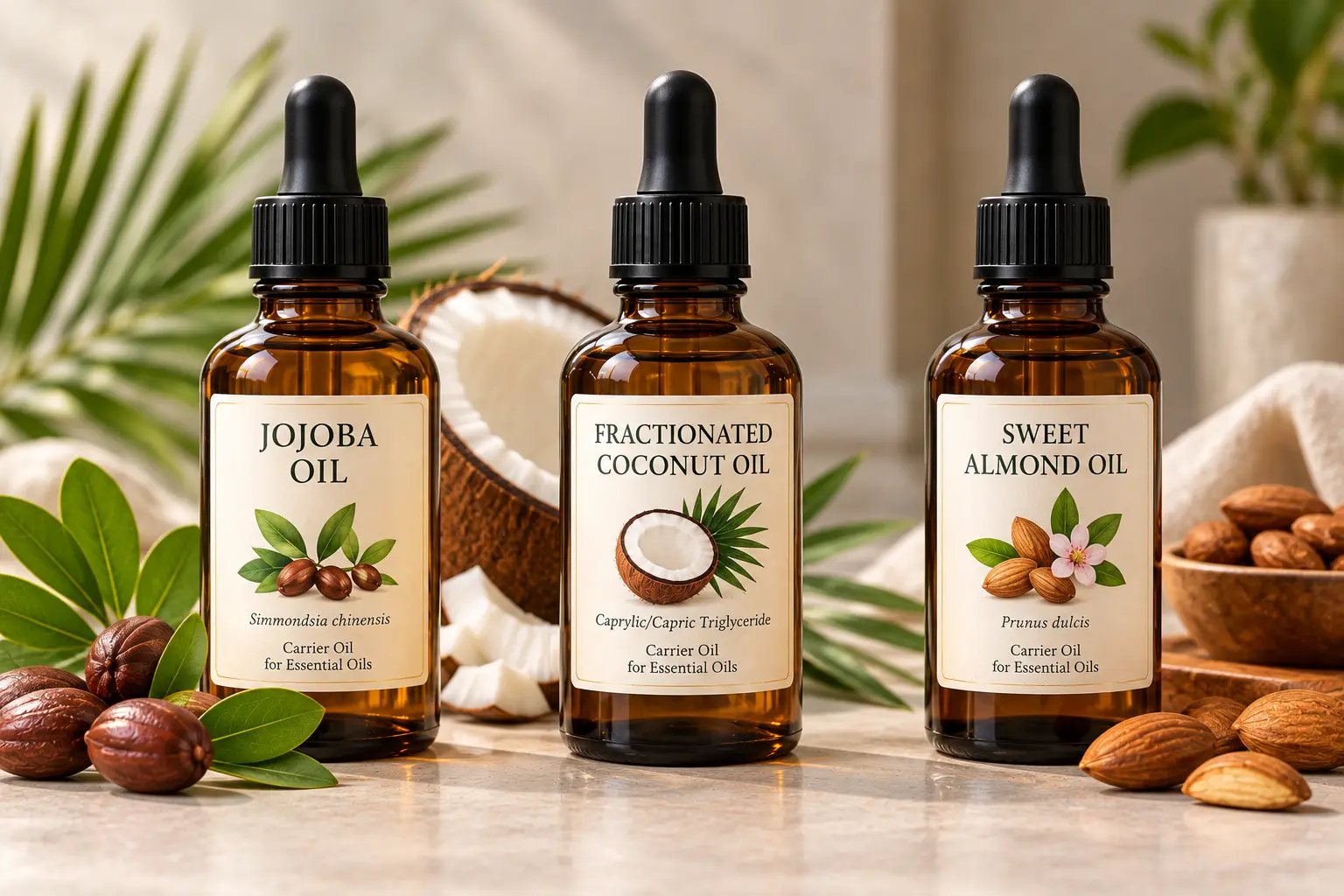
The best carrier oils for essential oils are jojoba, fractionated coconut oil and sweet almond oil. Jojoba is the most stable all-rounder for face and body. Fractionated coconut oil is light, almost odourless and stays liquid, so it suits roller bottles and essential oil perfume. Sweet almond oil is the classic massage base, as long as nobody using it has a nut allergy. Whichever you pick, dilution matters more than the oil: most adult body blends sit at 1 to 2 percent essential oil, and facial blends at 1 percent or less.
Below you will find how to choose a carrier, honest profiles of twelve base oils, a drop-by-drop dilution chart and answers to the questions our customers ask most. If you are building a perfume rather than a skin oil, our guide to the best carrier oils for perfume making covers fixation and scent throw in more detail.
What Is a Carrier Oil and Why Do Essential Oils Need Dilution?
A carrier oil, also called a base oil, is a fixed (non-volatile) oil pressed from seeds, nuts, kernels or fruit. It spreads a few drops of essential oil over a usable area of skin. Essential oils are volatile aromatic extracts, and they are strong: the Tisserand Institute notes that the essential oil in a bottle is 50 to 100 times more concentrated than in the plant.
Their advice is short: do not apply undiluted essential oils to your skin. According to the Tisserand Institute safety guidelines, skin reactions are the most common adverse reaction, and neat use is the most common cause. Two problems sit under that heading:
- Irritation: a local reaction that does not involve the immune system, usually from using too much.
- Sensitisation (allergic contact dermatitis): the immune system becomes primed to a substance, usually for life, and you may need to avoid that oil from then on.
Some oils also have a dermal limit, a maximum safe concentration on skin, set out in Tisserand and Young’s book Essential Oil Safety. The Institute’s essential oil dilution chart highlights two: clove bud at no more than 0.5 percent and lemon at no more than 2 percent.
How to Choose a Carrier Oil for Essential Oils
- Absorption. For a fast absorbing oil, choose fractionated coconut, grapeseed or apricot kernel. Avocado, olive and castor sit on the skin longer.
- Scent. Odorless carrier oils let the essential oils lead. Fractionated coconut and grapeseed are close to neutral; virgin coconut, olive, black seed and roasted argan have a smell of their own.
- Shelf life and oxidation. Oils high in polyunsaturated fats (linoleic and alpha-linolenic acid) turn rancid sooner. Jojoba and fractionated coconut are the most stable; rosehip is among the least.
- Skin type. Comedogenic ratings (a 0 to 5 scale) come largely from old rabbit ear tests on mostly undiluted ingredients, and rabbit ear skin is far more reactive than ours. Treat them as a rough hint and rely on patch testing.
- Allergies. Sweet almond and apricot kernel are nut or kernel oils. With a nut allergy, choose grapeseed or sunflower, or ask a doctor.
- Cold pressed or refined. Cold pressed oils keep more colour, scent and minor plant compounds. Refined oils are paler and more neutral.
Carrier Oil Comparison Table
Shelf life is relative and assumes a sealed bottle kept cool and dark. Always check the supplier’s best before the date.
| Carrier oil | Absorption | Scent | Shelf life | Best for | Cautions |
| Jojoba (Simmondsia chinensis) | Medium | Faint to near neutral | Very long | Face, body, roll-ons, perfume | Higher cost |
| Fractionated coconut (MCT) | Fast | Virtually odourless | Very long | Roller bottles, perfume, massage | Thin feel |
| Sweet almond (Prunus dulcis) | Medium | Very mild | Moderate | Massage, body oil | Nut allergy |
| Grapeseed (Vitis vinifera) | Fast | Near neutral | Short to moderate | Light body oil, nut-free option | Oxidises faster |
| Apricot kernel (Prunus armeniaca) | Fast to medium | Mild | Moderate | Face, body | Check nut allergies |
| Argan (Argania spinosa) | Medium | Mild nutty | Moderate | Face, hair, dry skin | Cost; avoid roasted grade |
| Olive (Olea europaea) | Slow | Strong, fruity | Moderate | Occasional balms | Barrier concerns |
| Sunflower (Helianthus annuus) | Medium | Mild | Short to moderate | Budget body oil | Pick high oleic |
| Avocado (Persea americana) | Slow | Earthy if unrefined | Moderate | Very dry skin, in blends | Heavy alone |
| Rosehip (Rosa canina) | Fast to medium | Earthy | Short | Small share of facial blends | Refrigerate |
| Castor (Ricinus communis) | Very slow | Faint | Long | Small share of lip or hair oils | Very thick |
| Black seed (Nigella sativa) | Medium | Strong, peppery | Moderate | Small share of blends | Rare severe reactions |
| Virgin coconut (Cocos nucifera) | Medium | Coconut | Long | Body balms | Solid below about 24°C |
The Best Carrier Oils for Essential Oils, Profiled
Jojoba Oil (Simmondsia chinensis)
Jojoba is technically a liquid wax: about 97 percent wax esters with only a trace of triglycerides. That structure makes it far more resistant to oxidation than most plant oils, so a sealed bottle lasts for years. It feels silky and suits almost every skin type. Golden jojoba has a faint nutty smell; refined jojoba is near neutral. The downside is price. Compare it with its closest rival in jojoba vs fractionated coconut oil for perfume.
Fractionated Coconut Oil (MCT)
Fractionation removes the long-chain fats, mainly lauric acid, from coconut oil and leaves medium chain triglycerides, chiefly caprylic and capric (often labelled caprylic/capric triglyceride). The result is clear, virtually odourless, very stable and liquid in an air-conditioned room. It absorbs fast with little greasiness, which makes it the standard for roller bottles. It offers less cushion than jojoba on very dry skin.
Sweet Almond Oil (Prunus dulcis)
The traditional massage oil: affordable, mild in scent and with plenty of slip. It is generally well tolerated, even by sensitive skin, and keeps for around a year or more if stored well. It comes from a tree nut, so avoid it for anyone with a nut allergy unless a doctor agrees, and label it clearly in anything you sell.
Grapeseed Oil (Vitis vinifera)
Pressed from seeds left over from winemaking, grapeseed is light, thin and near odourless, with around two thirds of its fatty acids as linoleic acid. It feels good on oily skin and is a useful nut-free option. That linoleic acid also means faster oxidation, so expect roughly a year of shelf life and buy small bottles.
Apricot Kernel Oil (Prunus armeniaca)
Similar to sweet almond but a little lighter, apricot kernel is a favourite for facial oils and sensitive skin blends. It keeps for around 12 to 18 months when stored properly. As a kernel oil, it needs the same nut allergy caution.
Argan Oil (Argania spinosa)
Argan comes from the kernels of a tree native to south-west Morocco. Cosmetic argan is pressed from unroasted kernels and smells mildly nutty; culinary argan uses roasted kernels and smells much stronger, so buy cosmetic grade. It is popular in face and hair oils, but the price means most formulators use it as part of a blend.
Olive Oil (Olea europaea)
“Can I use olive oil?” is a common question because everyone has it. It works for an occasional balm, but it is heavy and its smell competes with delicate essential oils. A 2013 study by Danby and colleagues found that olive oil applied to adult forearms twice daily for four weeks reduced the integrity of the outer skin layer and caused mild redness, while sunflower seed oil did not (study summary). We would not use it as a daily carrier.
Sunflower Oil (Helianthus annuus)
What about sunflower oil? It is a sensible budget carrier, and in the same study it preserved the skin barrier and improved hydration. High linoleic sunflower is lighter but oxidises faster; high oleic sunflower is more stable, so pick that for blends you plan to keep for a few months.
Avocado Oil (Persea americana)
Rich, slow to absorb and, when unrefined, green with an earthy smell. Alone it can feel heavy, but a portion of avocado in grapeseed or jojoba gives body oil more cushion for dry hands, feet and elbows.
Rosehip Seed Oil (Rosa canina)
What about rosehip oil? It is one of the most fragile carriers. Studies of Rosa canina seed oil report more than 77 percent polyunsaturated fatty acids and low resistance to oxidation, with rapid deterioration under UV light. Expect 6 to 12 months at best. Buy small amounts in dark glass, refrigerate after opening and use it as a minor part of a facial blend.
Castor Oil (Ricinus communis)
Can I use castor oil? Yes, but not as the main carrier. It is dominated by ricinoleic acid, which makes it extremely thick. The Cosmetic Ingredient Review panel found it was not a significant skin irritant, sensitiser or photosensitiser in human clinical tests, and it is very stable. It will not flow through a roller ball, so use a small amount inside a lighter carrier for lip, beard or hair oils.
Black Seed Oil (Nigella sativa)
Black seed oil has a strong, peppery, herbal smell that dominates most blends. Published case reports describe rare but severe skin reactions after topical use, with patch tests pointing to thymoquinone, one of its main aromatic constituents. If you include it, keep it to a small share, patch test first and stop at any redness or itching.
Carrier Oils to Avoid or Use With Care
- Rancid oil. If a carrier smells like crayons, old paint or stale nuts, it has oxidised. Throw it out.
- Nut and kernel oils for anyone with a nut allergy.
- Thick oils in roller bottles. Castor, olive and avocado drag and leak.
- Water, milk or salt as a “carrier”. Essential oils do not mix with water. The Tisserand Institute warns that drops in a bath float as undiluted droplets that can sting, and that milk and Epsom salts do not disperse them.
- Unknown cooking oil blends. Generic “vegetable oil” will dilute essential oils, but you rarely know what is in it or how fresh it is.
Essential Oil Dilution Chart: Drops per 10 ml and 30 ml
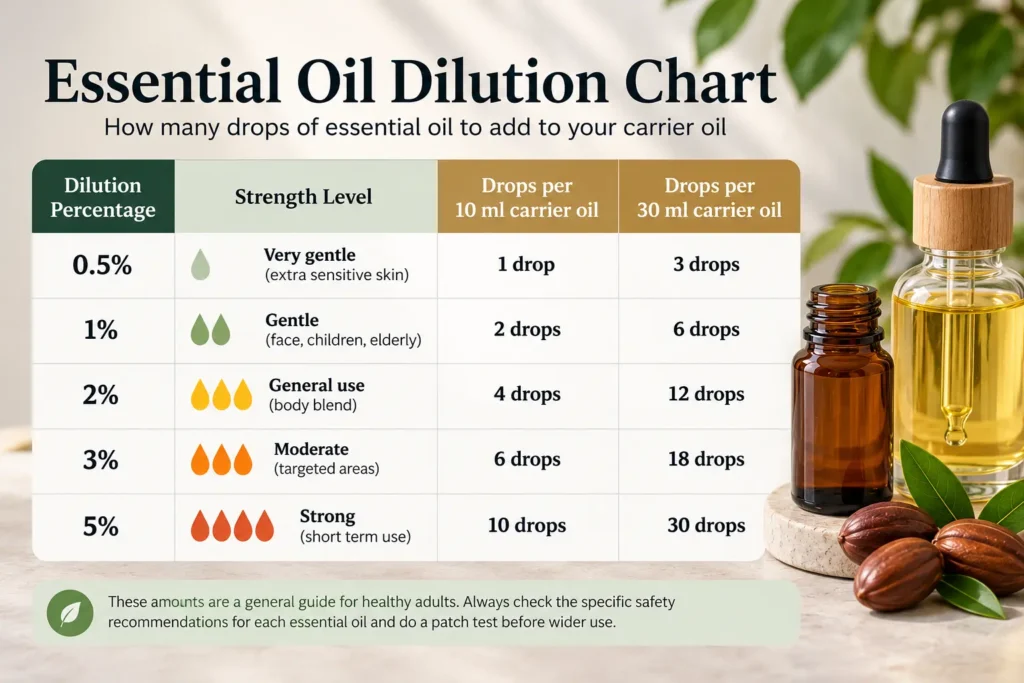
The Tisserand Institute’s chart assumes 30 drops of essential oil per millilitre, based on studies where 20 average drops weighed about 0.66 g. Real drops range from about 20 to 40 per ml, so treat these as estimates and round down. Many American charts assume about 20 drops per ml, which is why they list 6 drops per ounce for 1 percent.
The formula: drops = ml of carrier x 30 x (percentage / 100). A 2 percent blend in a 10 ml roller bottle is 10 x 30 x 0.02 = 6 drops.
| Use | Dilution | Drops per 10 ml | Drops per 30 ml |
| Babies and children under 2 | Ask a qualified professional first | Not covered here | Not covered here |
| Children 2 to 6 years (conservative) | 0.5 to 1% | 1 to 3 | 4 to 9 |
| Face, sensitive skin, older adults | 0.5 to 1% | 1 to 3 | 4 to 9 |
| Daily body oil, large areas (adult) | 1 to 2% | 3 to 6 | 9 to 18 |
| Massage oil, occasional (adult) | 2%, up to 3% | 6 to 9 | 18 to 27 |
| Roll-on for a small area (adult) | 2 to 3% | 6 to 9 | 18 to 27 |
| Essential oil perfume (adult) | Never above any single oil’s dermal limit | Calculate per oil | Calculate per oil |
For ages 2 to 6, Tisserand and Young suggest around 1 percent and other aromatherapy bodies advise 0.5 to 1 percent; we show the lower range. If you are pregnant, have a skin condition, epilepsy or asthma, or take prescribed medication, the Tisserand Institute advises seeing a doctor before using essential oils. In multi-oil blends, the total goes in the chart while each oil also stays under its own limit.
How to Patch Test a New Carrier or Blend
- 1. Mix the blend at the exact dilution you plan to use.
- 2. Apply a small amount to the inner forearm and cover it with a plaster.
- 3. Leave it for up to 48 hours, keeping the area dry.
- 4. Check for redness, itching, swelling or rash. If anything appears, wipe the area with plain carrier oil, wash with mild soap and do not use that blend.
- 5. If the person has a history of allergies, test the carrier on its own too.
Phototoxic Essential Oils: Something No Carrier Can Fix
Some expressed (cold pressed) citrus oils contain furocoumarins, such as bergapten, that react with UV light and can burn or mark sun-exposed skin. A carrier dilutes them but does not neutralise them. Tisserand and Young’s maximum levels for leave-on skin products are roughly: bergamot 0.4%, lime 0.7%, bitter orange 1.25%, lemon 2% and grapefruit 4% (all expressed).
Distilled citrus oils are not phototoxic, because furocoumarins do not pass over in distillation, and furocoumarin-free bergamot (FCF) is also safe in this respect. Sweet oranges are generally considered non-phototoxic. In a city as sunny as Dubai, keep phototoxic blends for covered skin or switch to distilled or FCF versions. The International Fragrance Association (IFRA) also caps total bergapten at 15 ppm in finished products that combine furocoumarin-containing ingredients.
Storage and Shelf Life in Hot Climates Like the UAE
Heat, light and air age a carrier oil, and the UAE supplies plenty of the first two. Summer daytime temperatures in Dubai regularly pass 40°C, and parked cars get far hotter.
- Store oils in amber or cobalt glass, in a cupboard away from windows and ovens.
- Never leave oils in a car in summer.
- Refrigerate fragile oils such as rosehip and grapeseed after opening.
- Keep bottles tightly capped and decant into smaller bottles as you use them, so less air sits above the oil.
- Label every blend with the date and carrier, and mix small batches.
- Smell before use. A sharp, crayon-like note means rancidity.
- Essential oils age too. Limonene and linalool oxidise in air to form hydroperoxides, which are known skin sensitisers, and research shows these build up over time.
Black Seed, Argan and Other Regional Carriers
Across the Arabian Gulf, black seed is known as Habbat al-Barakah, the “seed of blessing”, and it has a long history in folk use and Prophetic medicine traditions. That is why “can I use black seed oil?” comes up so often from UAE and Saudi customers. As a carrier, treat it as an active, strongly scented ingredient and use it sparingly.
Argan has a parallel story. The tree is endemic to south-west Morocco, and in 2014 UNESCO added “Argan, practices and know-how concerning the argan tree” to its Representative List of the Intangible Cultural Heritage of Humanity (UNESCO decision). Much of the oil comes from women’s cooperatives, so traceable cosmetic grade argan is worth paying for.
Carrier Oil for Essential Oil Perfume vs Body Oil
• Essential oil perfume needs a carrier that is odourless, clear, stable and liquid at room temperature. Fractionated coconut and jojoba are the standard picks; see our guide to the best carrier oil for roll-on perfume.
• Body and massage oils need slip and cushion. Sweet almond, apricot kernel, sunflower and grapeseed work well, often with some jojoba for stability.
Perfume also runs at higher concentrations, which is where dermal limits bite: a citrus-heavy blend can easily exceed the bergamot or lime limits above. To see how naturals are balanced in finished fragrance, read about essential oil blends used in luxury perfumes.
Carrier Oils vs Ready-Made Perfume Oils
If you want a fragrance to wear or sell rather than a massage oil, blending essential oils yourself means managing dermal limits, phototoxicity, oxidation and batch consistency on your own. Ready-made perfume oils arrive balanced and at a consistent strength, which is why many retailers and new brands start there.
Bin Tammam Perfumes in Deira, Dubai supplies wholesale perfume oils across more than 2,000 oil variations, plus private label perfume oils for brands that want their own name on the bottle. We work samples first: order fragrance sample kits to test scent and longevity before buying volume, or contact our team to discuss your project.
Frequently Asked Questions
What’s the best carrier oil for essential oils?
For most people, jojoba, because it is stable, mild and suits most skin types. Fractionated coconut oil is the best odourless, fast absorbing option for roller bottles and essential oil perfume, and sweet almond oil is the classic massage choice if there is no nut allergy.
Can I use olive oil as a carrier oil?
Occasionally, but it is a poor daily carrier. It is heavy, strongly scented, and a 2013 study found regular use disrupted the skin barrier in adult volunteers. Sunflower, jojoba or sweet almond are better.
Can I use coconut oil as a carrier oil for essential oils?
Yes, but check the type. Virgin coconut oil smells of coconut and is solid below about 24°C, so it sets in air-conditioned rooms. Fractionated coconut oil stays liquid, has almost no scent and suits most blends better.
Can I use castor oil as a carrier oil?
Only as a small part of a blend. It is stable and generally well tolerated, but too thick to spread easily or run through a roller ball. Mix a little into jojoba or sweet almond.
Can I use black seed oil as a carrier oil?
With care. Its peppery smell overpowers most essential oils, and rare but serious allergic skin reactions have been reported after topical use. Keep it to a small share of a blend and patch test first.
Can I use vegetable oil or sunflower oil?
Sunflower oil is a reasonable budget carrier, and high oleic sunflower keeps longer. Generic “vegetable oil” will work in a pinch, but a labelled cosmetic carrier tells you exactly what you are using.
Can you use grape seed oil, and what about rosehip oil?
Yes. Grapeseed is light, near odourless and nut-free, but oxidises faster than jojoba. Rosehip is even more fragile: refrigerate it and use it as a minor part of a facial blend.
Is jojoba better than other carrier oils?
For shelf life and versatility, yes, because its wax ester structure resists oxidation. For feel and budget, not always: fractionated coconut is lighter and cheaper, and sweet almond gives more slip for massage.
Do I need a carrier oil for a diffuser?
No. Most ultrasonic diffusers use water, and nebulising diffusers are designed for pure essential oil. A thick carrier can clog the mechanism. Follow the manufacturer’s instructions and diffuse in intervals, roughly 30 to 60 minutes on and 30 to 60 minutes off, as the Tisserand Institute suggests.
Choosing the Best Carrier Oil for Essential Oils
Start with the use. For faces and everyday body oils, jojoba is the safest all-rounder. For roll-ons and essential oil perfume, choose fractionated coconut or jojoba. For massage, sweet almond, apricot kernel, grapeseed or high oleic sunflower all work. The best carrier oils for essential oils only do their job when the dilution is right: follow the chart, respect dermal limits, keep phototoxic citrus off sun-exposed skin, patch test and store everything cool and dark.