
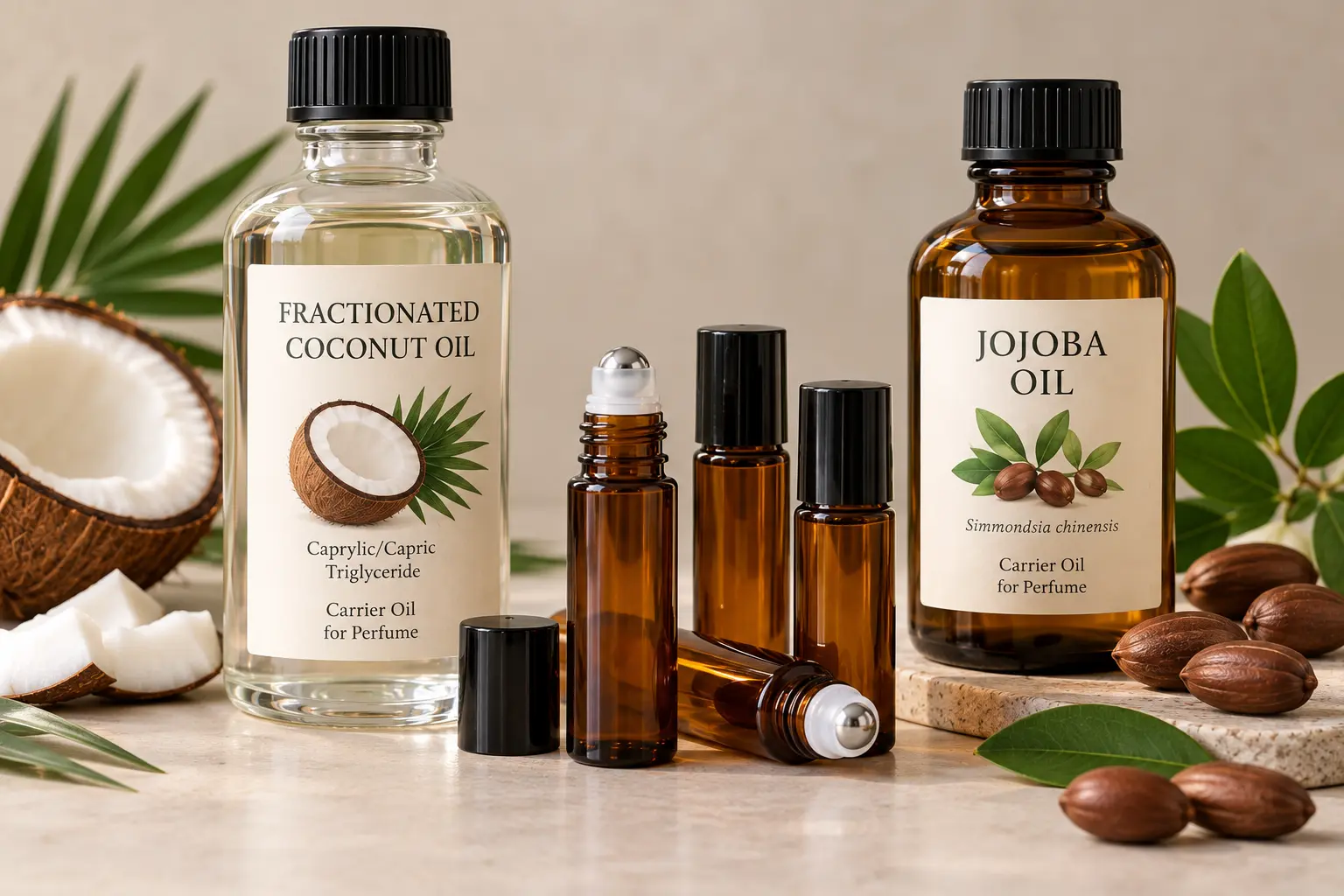
Quick answer: the best carrier oil for roll-on perfume is fractionated coconut oil (caprylic/capric triglyceride). It is thin enough to glide through a roller ball without clogging, it has almost no smell of its own, and it resists oxidation far better than most plant oils, so your blend smells the same months later as it did on the day you filled it. Jojoba oil (Simmondsia chinensis) is the best natural alternative if you want a slightly richer feel on skin, and a half and half mix of the two is a popular choice among perfumers.
We supply perfume oils, attars and filled roll-ons from Deira, Dubai, to shops, resellers and new brands across the UAE, the GCC and beyond. The questions we hear most are practical: which oil, how much fragrance, which roller, and why does the bottle leak? This guide answers them, with honest pros and cons, a filling method, three starter formulas and advice on selling under your own name.
Why Roll-On Perfume Needs a Thin, Stable, Low-Odour Carrier
A roller bottle is simple packaging, but it is fussy about what goes inside. The ball picks up a thin film of oil each time it turns. Too thick, and the ball drags or sticks. Scented, and the oil muddies the perfume. Rancid, and the whole bottle is ruined. Three properties decide whether a carrier works in a perfume roller.
Glide and viscosity
Viscosity is how thick or runny an oil is. Low-viscosity oils like fractionated coconut oil flow freely around the ball, so every stroke delivers an even line of scent. Heavier oils leave a sticky film on the ball and housing that catches dust and dries into a crust. Thin oils have one downside: a badly fitted roller will weep. The fix is good packaging, not a thicker oil.
Odour and colour
A good perfume carrier should be close to invisible. Fractionated coconut oil and refined jojoba have little or no scent, while unrefined oils can smell nutty or oily and flatten delicate florals and citrus. For a deeper look at every option, read our guide to the best carrier oils for perfume making.
Oxidation and shelf life
Oils high in polyunsaturated fatty acids react with oxygen, light and heat, and that oxidation makes them smell stale or rancid. A roll-on is opened daily and carried in warm bags, so stability matters more here than in a bottle kept in a cupboard. This is why fractionated coconut oil and jojoba lead, and almond and grapeseed come lower down.
Best Carrier Oil for Roller Ball Bottles: Ranked
Here is how the common carriers perform in a perfume roller, based on their known properties and how they behave in a roller bottle.
1. Fractionated coconut oil (caprylic/capric triglyceride)
Fractionated coconut oil (FCO) is made by separating the long-chain fats out of coconut oil, leaving mainly caprylic (C8) and capric (C10) triglycerides. It stays liquid at room temperature, is colourless and almost odourless, absorbs quickly and resists oxidation very well.
• Pros: excellent glide, no scent, very long shelf life, light non-greasy feel, widely available.
• Cons: so thin that it can seep from a loose roller; some people find it slightly drying compared with jojoba.
2. Jojoba oil (Simmondsia chinensis)
Jojoba is a liquid wax made almost entirely of wax esters, not a typical triglyceride oil. That structure makes it highly resistant to oxidation, and suppliers commonly quote a shelf life of two to three years. Golden jojoba has a faint scent; refined (clear) jojoba is close to neutral.
• Pros: stable, soft skin feel, a good choice for natural product lines.
• Cons: costs more, golden grades add a light colour and scent, and it feels a little heavier on the ball.
We compare the two leaders side by side in jojoba vs fractionated coconut oil for perfume.
3. MCT oil
MCT stands for medium-chain triglycerides. Cosmetic MCT oil is essentially the same caprylic/capric material as FCO and performs the same way in a roller. The catch is grade: MCT sold as a food supplement may differ in its C8 to C10 balance, so buy a cosmetic-grade, unscented product.
4. Sweet almond oil
Sweet almond oil has a pleasant slip, but it is prone to oxidation and typically keeps for about a year, so it can smell stale before the bottle is finished in a warm climate. It also raises a nut allergy concern if you sell. Fine for a home blend used quickly; not our pick for retail stock.
5. Grapeseed oil
Grapeseed oil is light and absorbs fast, but it is high in linoleic acid, a polyunsaturated fat, and oxidises quickly. Expect around a year or less. Use it only for small batches you will finish within weeks.
Oils to avoid in a roller bottle
• Virgin or regular coconut oil: turns solid in cool, air-conditioned rooms and smells of coconut.
• Olive and heavy kitchen oils: too thick and too scented.
• Water or hydrosols: they do not mix with oil and invite microbial growth.
• Perfumer’s alcohol: it evaporates quickly through a roller fitting. Alcohol-based perfumes belong in spray bottles.
Carrier comparison for roller use
| Carrier | Glide | Absorption | Odour | Shelf life | Clog risk | Best for |
| Fractionated coconut oil | Excellent | Fast | None | Very long, oxidation resistant | Very low | All roll-ons, retail stock |
| Jojoba (refined) | Very good | Medium | Very faint | Long (often 2 to 3 years) | Low | Natural lines, attar blends |
| MCT oil (cosmetic grade) | Excellent | Fast | None | Very long | Very low | Same uses as FCO |
| Sweet almond oil | Good | Medium | Mild nutty | About 1 year | Medium | Home blends used quickly |
| Grapeseed oil | Good | Fast | Mild | About 1 year or less | Medium | Small, short-life batches |
| Virgin coconut oil | Poor when cool | Medium | Coconut | Moderate | High | Not recommended |
How Much Fragrance Oil Goes in a Roll-On? Ratios and IFRA
Most makers work between 10% and 20% fragrance oil in the carrier. Around 15% is a sensible start: noticeable without being overpowering. Go towards 20% for a strong evening scent and 10% for a soft office blend. In a 10 ml roller:
• 10%: 1 ml fragrance oil + 9 ml carrier
• 15%: 1.5 ml fragrance oil + 8.5 ml carrier
• 20%: 2 ml fragrance oil + 8 ml carrier
Measure in millilitres with a graduated pipette or syringe, or by weight on a 0.01 g scale. Drop sizes vary, so drops are not reliable for repeatable batches.
Check the IFRA limit first
IFRA, the International Fragrance Association, publishes standards that cap how much of certain materials can be used in each product type. Fine fragrance, including non-alcoholic perfume oil, falls under IFRA Category 4. A reputable supplier should provide an IFRA certificate for each oil showing the maximum percentage per category. Use the lower of your target strength and the IFRA maximum. The current standards are published on the IFRA standards page.
Concentrated perfume oils and attars
Some concentrated perfume oils and attars are sold ready to wear, while others are compounds meant to be diluted. Ask your supplier which one you have before adding any carrier, and ask for the IFRA certificate either way. Whatever you make, do a patch test on a small area of the inner arm before wider use, and stop using any blend that irritates.
How to Make Roll-On Perfume Oil: Filling a 10 ml Roller Bottle Step by Step
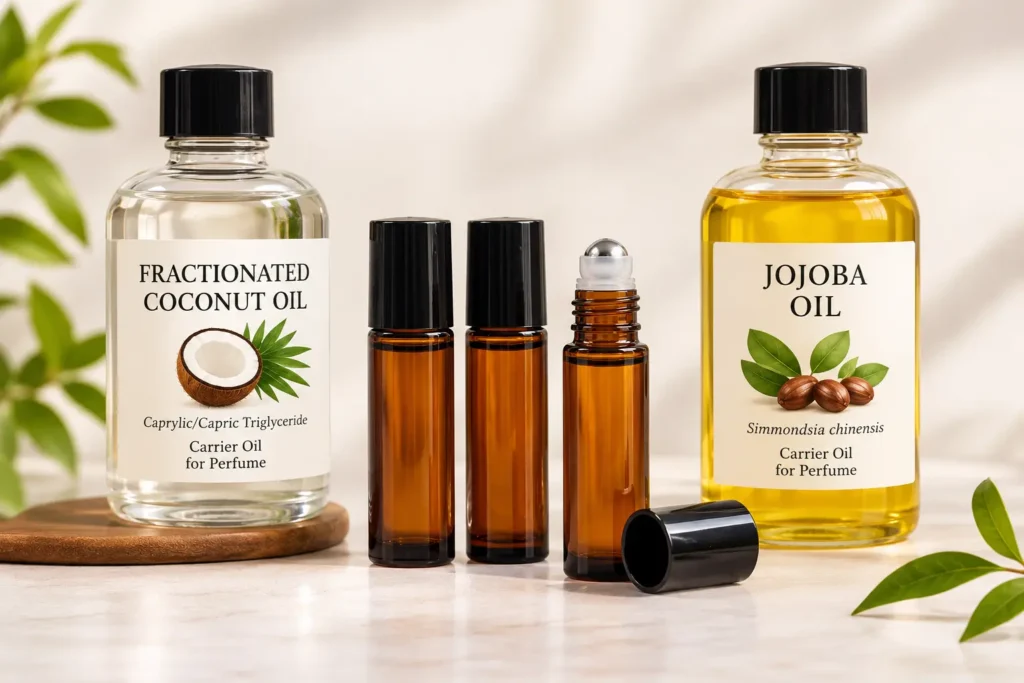
This is a simple, repeatable method. It works for fragrance oils, essential oils and attar blends. For a wider look at blending your own scents, see how to make perfume oil at home.
What you need
• A clean 10 ml glass roller bottle with fitting and cap
• Your fragrance oil or oils
• Carrier oil, ideally fractionated coconut oil or jojoba
• A graduated pipette or syringe, a small funnel, paper towels and a label
Filling steps
1. Clean and dry everything. Wash, rinse and dry the bottle and fitting fully. Leftover water clouds the oil.
2. Decide your strength. For 15% in 10 ml: 1.5 ml fragrance, 8.5 ml carrier, within the IFRA limit.
3. Add the fragrance first. Pipette it into the empty bottle. With several oils, add base notes first, then heart, then top.
4. Top up with carrier. Fill the carrier to just below the shoulder, leaving a small air gap.
5. Press the roller fitting in firmly. Press it down evenly with your thumb, or through a cloth, until it sits flush.
6. Cap and mix. Screw the cap on tightly and roll the bottle between your palms for 20 to 30 seconds.
7. Wipe and label. Label with scent name, strength and date.
8. Let it rest. Leave it upright in a cool, dark place for at least 48 hours. Blends often smell rounder after a few days.
9. Test on skin. Patch test first, then wear it for a full day to judge the opening and the dry down.
10. Record the formula. Note exact quantities for the next batch.
How to make essential oil roll-on perfume
The method is the same, but essential oils need extra care. Many have their own IFRA restrictions, so check the supplier’s data before choosing your percentage. Cold-pressed bergamot can cause skin reactions in sunlight; choose bergapten-free (FCF) bergamot for a roll-on worn outdoors. Essential oil blends also tend to fade faster, because many natural top notes are very volatile.
Roller Ball Types and Roller Bottle Sizes
Stainless steel vs glass vs plastic roller balls
| Roller ball | Strengths | Watch out for |
| Stainless steel | Smooth, consistent glide, cool feel on skin, durable, premium look. The most popular choice for perfume roll-ons. | Costs slightly more; buy from a supplier who specifies the steel grade. |
| Glass | Inert, smooth, attractive in clear packaging. | Can chip or crack if dropped; with thicker oils it may stick more than steel. |
| Plastic (PP) | Lowest cost, light, fine for samples and giveaways. | Less premium feel; glide can be uneven; test compatibility with your oils over a few weeks. |
Common roller bottle sizes
Roller vials are made in a range of volumes. The sizes below are widely stocked by packaging suppliers, and the 3 ml, 6 ml and 8 ml sizes are especially familiar in the attar trade.
| Size | Typical use | Notes |
| 3 ml | Samples, testers, attar miniatures | Ideal for sample kits and gift sets |
| 5 ml | Trial size, discovery sets | Good price point for first-time buyers |
| 6 ml | Classic attar and perfume oil size | Common in Gulf perfume shops |
| 8 ml | Attar roll-ons, mid-size retail | Popular for concentrated oils |
| 10 ml | Standard retail roll-on | The most common size for roll-on perfume oil |
| 12 to 15 ml | Larger retail, value packs | Less pocket-friendly, more product per sale |
Amber vs clear glass
Amber glass filters out much of the ultraviolet light that speeds up oxidation, which is why it is the standard for essential oils. Clear glass shows off an oil’s colour but gives little UV protection, so keep clear bottles boxed or away from windows. For stock in a sunny shop window, choose amber or an outer carton.
How to Prevent Leaking and Clogging in a Perfume Roller
• Do not overfill. Leave a small air gap below the fitting. A full bottle forces oil up and around the housing.
• Seat the fitting fully. A fitting that is not pressed flush will weep, especially with a thin carrier.
• Match fitting and bottle. Buy rollers and bottles as a set from one supplier. Neck sizes that are almost the same are the main cause of leaks.
• Keep it upright in transport. Store and carry roll-ons standing up, with the cap tight.
• Use a thin, stable carrier. Thick or oxidised oils leave a gummy residue that stops the ball turning.
• Wipe the ball. If it sticks, wipe it and roll it on a clean tissue. Lotion and makeup residue transfer back to the ball.
• Avoid heat. Warm oil expands and pushes past the fitting.
Roll-Ons and the Attar Tradition in the UAE and GCC
Long before roller balls, the Gulf wore its perfume as oil. Attar, from a Persian word meaning essence or fragrance, describes concentrated, alcohol-free perfume oils. Traditional attar bottles have a glass stopper or stick that doubles as an applicator, pressed lightly onto the skin. The most prized of these oils is dehn al oud, the Arabic name for oud oil, often translated as the oil or fat of the wood, distilled from resinous agarwood.
The roll-on is the modern form of that habit: the same close, alcohol-free wear with less mess. That is why attar roll-ons in 3 ml, 6 ml and 8 ml sizes are a familiar sight in Deira’s perfume souqs and across the GCC. Browse our Arabian attar oils wholesale range for traditional profiles.
Best carrier oil for attar
Many traditional attars and oud oils are worn undiluted, so first check if yours needs a carrier at all. When you do dilute, for a lighter product or lower price point, fractionated coconut oil keeps the profile true, while refined jojoba adds softness that suits rose, musk and amber. Avoid scented or heavy carriers that compete with oud.
Roll-On Perfume in Gulf Heat, Cars and Hand Luggage
Heat and cars
In the UAE summer, a parked car gets far hotter than the air outside. Heat speeds up evaporation and oxidation, can change how a fragrance smells, and makes oil expand and push past the roller fitting. Keep your roll-on in your bag, not on the dashboard, and store spares in a cool, dark cupboard. Our guide on how to store fragrance oils covers bulk stock too.
Travel rules for liquids in cabin bags
Roll-ons are easy to fly with. At UAE airports, hand luggage liquids are generally limited to containers of 100 ml or less, in one transparent resealable bag of up to one litre. The United States applies a similar 3.4 oz (100 ml) limit under the TSA liquids rule. Some airports, including several in the UK, have changed their liquids screening with new scanners, so rules differ. Check the UK hand luggage guidance or your departure airport before you fly. A 10 ml roller sits well inside the usual limits; pack it upright with the cap tight.
How to Make Roll-On Perfume Last Longer
A carrier oil evaporates far more slowly than alcohol, so an oil perfume sits close to the skin and releases gradually. The trade-off is sillage: a roll-on projects less than a spray. Longevity depends mostly on the fragrance, especially its base notes, and on concentration, more than on the carrier.
• Apply to moisturised skin. Oil holds better on skin that is not dry.
• Roll onto pulse points and do not rub your wrists together.
• Choose blends with strong base notes such as oud, amber, musk, sandalwood or vanilla for long wear.
• Increase strength within the IFRA limit rather than adding more carrier.
• Carry the roller and touch up at midday.
Three Roll-On Perfume Formulas to Try (10 ml)
These formulas use ready-made fragrance oils, so they are easy to repeat. Adjust to taste, keep each oil within its IFRA limit, and rest each blend before judging it. If you are new to building accords, our guide to fragrance notes: top, middle and base explains how the layers work.
| Formula | Fragrance oils | Carrier | Strength |
| Fresh (citrus and musk) | 0.6 ml bergamot or citrus fragrance oil, 0.5 ml marine or green tea, 0.4 ml white musk | 8.5 ml fractionated coconut oil | 15% |
| Floral (rose and jasmine) | 0.7 ml rose, 0.4 ml jasmine, 0.4 ml sandalwood | 4.5 ml jojoba + 4 ml fractionated coconut oil | 15% |
| Oud and amber | 0.8 ml oud, 0.6 ml amber, 0.3 ml saffron or rose, 0.3 ml musk | 8 ml fractionated coconut oil or jojoba | 20% |
The fresh blend suits daytime and hot weather. The floral blend works well as a roll on perfume oil for women, though rose is worn by men across the Gulf too. Oud oils vary widely in strength, so start lower if yours is intense.
Selling Roll-On Perfume: Wholesale and Private Label
Fill your own or buy finished roll-ons
Filling your own gives full control over the formula, but takes time, packaging stock and quality checks. Buying roll on perfume oil wholesale, already filled, lets you sell from day one. Many new sellers start with filled stock, learn what sells, then move to their own formulas.
Private label, MOQ and sampling
With private label perfume oils, you choose the fragrances and we supply them filled into roll-ons under your brand. The MOQ (minimum order quantity) depends on the bottle, fitting and label you choose, so ask for a quote on your exact specification. Test before you commit: order fragrance sample kits, wear the oils for several days and see which ones customers come back for.
Packaging checklist for retail roll-ons
• Matched bottle and stainless steel roller fitting from the same batch
• Amber, frosted or boxed glass for light protection
• Labels that meet the rules of the country you sell in, with batch number
• IFRA certificate on file for each fragrance
• Shrink band or outer box for transport
Common Mistakes With Roller Ball Perfume
• Using kitchen oils or virgin coconut oil that go solid or smell.
• Overfilling the bottle, then wondering why it leaks.
• Ignoring IFRA limits and adding fragrance until it smells strong.
• Judging the blend the same day instead of after a rest.
• Storing stock in clear glass in a sunny window or a hot car.
• Skipping the patch test.
FAQ: Carrier Oils for Roll-On Perfume
What is the best carrier oil for a roller ball?
Fractionated coconut oil. It is thin, clear, odourless and very stable, so it glides smoothly and does not clog. Jojoba is the best natural alternative.
Does fractionated coconut oil make perfume last longer?
An oil base usually wears longer on skin than an alcohol spray, because oil evaporates more slowly. But FCO adds no extra longevity compared with other good carriers; the fragrance and its concentration matter most.
How much fragrance oil goes in a 10 ml roller bottle?
Most roll-on perfumes use 10 to 20% fragrance oil, so 1 to 2 ml in a 10 ml bottle, with the rest carrier oil. Never go above the maximum on the oil’s IFRA certificate.
What is the best carrier oil for attar?
Many attars are worn undiluted. If you do dilute, fractionated coconut oil keeps the scent true and refined jojoba adds softness. Avoid scented or heavy oils that compete with oud and rose.
How do I make essential oil roll-on perfume?
Add the essential oils first, top up with carrier, press in the fitting and let it rest. Keep each oil within its safe usage level and patch test first.
Can I take a roll-on perfume in my hand luggage?
Usually yes. A 10 ml roller is well under the common 100 ml container limit, but rules vary by airport, so check before travelling.
Can I buy roll-on perfume oil wholesale with my own brand?
Yes. We supply filled roll-ons wholesale and under private label from Dubai, with samples first so you can choose your range before ordering in bulk.
Final Word: Choosing the Best Carrier Oil for Roll-On Perfume
For most people the best carrier oil for roll-on perfume is fractionated coconut oil, with jojoba as the natural alternative. Keep the fragrance at 10% to 20% and inside its IFRA limit, use a stainless steel roller in amber glass, fill below the shoulder and keep it out of the heat. Your roll-on will glide, stay clean and smell right to the last drop.
If you want to sell roll-ons rather than make them one by one, we can help with filled stock, private label and sample kits from our shop in Deira. Contact Bin Tammam Perfumes to request samples or a quote.