
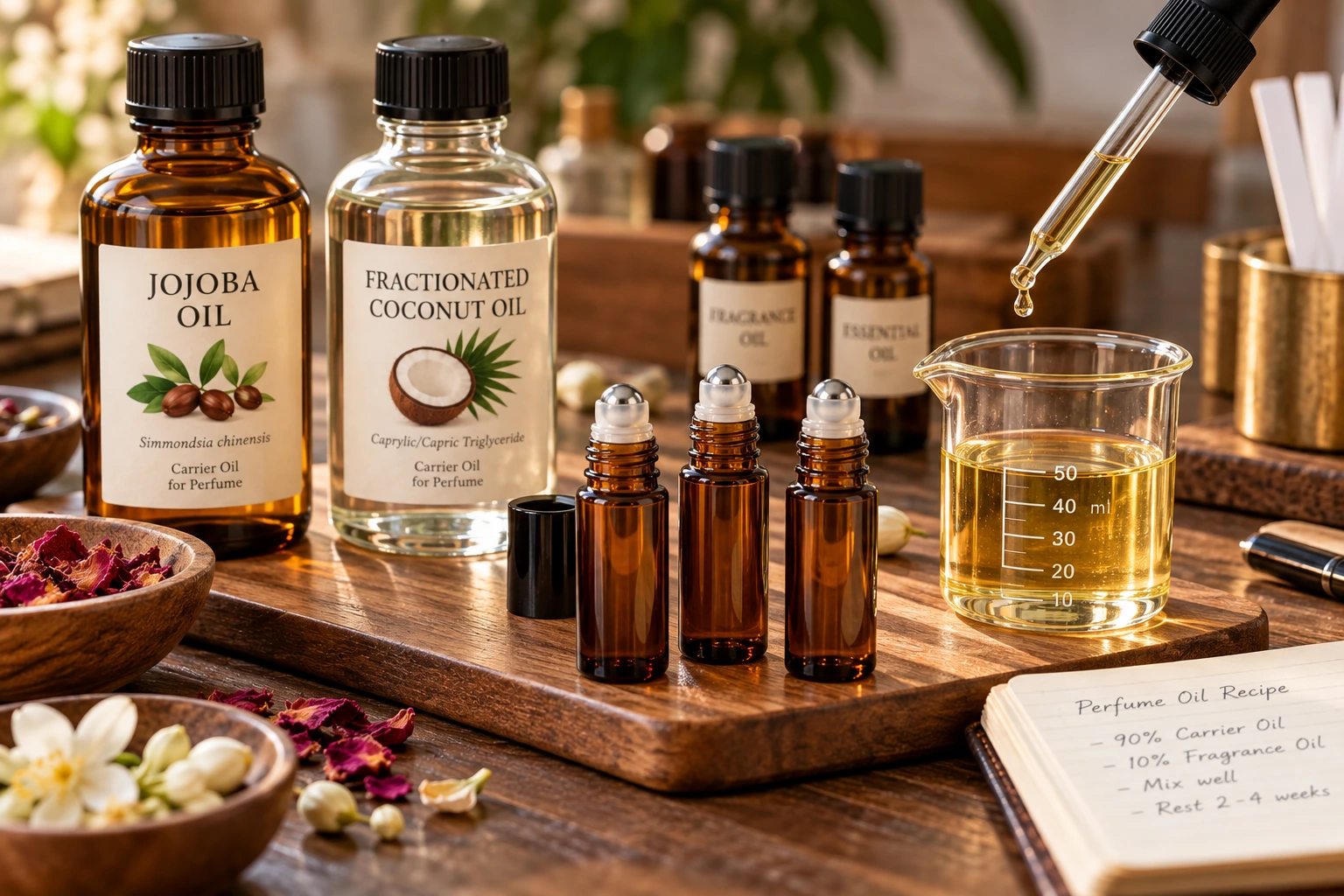
Short answer: here is how to make perfume oil at home: blend a skin-safe fragrance oil or a small set of essential oils into a light carrier oil such as jojoba or fractionated coconut oil, bottle it in clean amber glass, and let it rest for two to four weeks before you wear it. With cosmetic-grade fragrance oils, 10 to 15% is a common starting concentration for a roll-on, going higher only when the oil’s IFRA certificate allows it. Essential oil blends need much lower, more careful dilution.
We supply perfume oils to retailers and brand founders from Deira, Dubai, and many of our wholesale clients started exactly here: a few bottles, a pipette and a notebook. Below is the method we teach new customers, with real measurements, three starter recipes, safety rules and storage advice for a hot climate like the UAE.
What Is Perfume Oil, and How Is It Different from Alcohol Perfume?
A perfume oil is fragrance dissolved in a carrier oil instead of perfumer’s alcohol (ethanol). With no alcohol to flash off, the scent warms on the skin and releases slowly. Oil-based perfumes sit closer to the body and project less than a spray, but they evaporate more slowly, so many people find they last longer on skin.
The format has deep roots. Traditional attars from Kannauj in India are made by distilling flowers or roots straight into sandalwood oil using copper stills (the deg and bhapka). In the Gulf, oud oil (dehn al oud) is applied to pulse points and often layered under a spray. When you learn how to make oil based perfume at home, you are working in the same family as these attars.
- Perfume oil: carrier oil base, no alcohol, applied with a roller or dabber, wears close to the skin.
- Alcohol perfume: ethanol base, sprayed, louder opening and more projection, top notes evaporate faster.
Equipment and Ingredients You Need
You do not need a lab, just clean glass, accurate measuring and patience.
| Item | What it is for | Practical tip |
| Carrier oil (jojoba or fractionated coconut oil) | The perfume base oil that dilutes and carries the scent | A 100 ml bottle is plenty for learning |
| Fragrance oils or essential oils | The scent itself | Choose cosmetic-grade oils supplied with an IFRA certificate and safety data sheet (SDS) |
| Small glass beakers | Mixing the fragrance concentrate | Glass is easy to clean and does not hold old smells like some plastics |
| Graduated pipettes (1 ml and 3 ml) | Accurate transfers of each oil | Use a fresh pipette for every material to avoid cross-contamination |
| Digital scale reading to 0.01 g | Repeatable formulas by weight | Weighing is far more accurate than counting drops |
| 10 ml roller bottles or dropper bottles | Final packaging | Amber glass protects the blend from light |
| Paper scent strips (blotters) | Smelling each material and the blend | Write the name on each strip in pencil |
| Notebook or spreadsheet | Recording every formula and batch | Note exact amounts, date and batch number |
| Nitrile gloves and labels | Clean, safe handling | Keep concentrated oils off your skin |
Choosing the Best Carrier Oil for Perfume
The carrier makes up most of the bottle, so the ideal perfume base oil is close to odorless, light on skin and slow to go rancid. Our comparison of the best carrier oils for perfume making covers more options, but three oils handle almost every home recipe.
Jojoba Oil (Simmondsia chinensis)
Jojoba is technically a liquid wax ester rather than a true oil (a triglyceride), which makes it very resistant to oxidation. Golden jojoba has a faint nutty smell, while clear jojoba is close to odorless and suits delicate florals. It feels silky and is commonly quoted as stable for two to three years or longer when stored well.
Fractionated Coconut Oil (Caprylic/Capric Triglyceride)
Fractionated coconut oil (FCO) is regular coconut oil with the long-chain fatty acids removed, leaving mainly caprylic and capric triglycerides. It stays liquid, is clear and odorless, and suppliers typically quote a shelf life of 24 to 36 months. On ingredient labels it appears as Caprylic/Capric Triglyceride. It is light and non-greasy, ideal for roll-ons.
Sweet Almond Oil (Prunus amygdalus dulcis)
Sweet almond oil is affordable, but it has a mild scent, oxidizes faster than jojoba or FCO, and comes from a tree nut. Avoid it if anyone wearing the perfume has a nut allergy, and for anything you gift or sell.
| Carrier oil | Scent | Skin feel | Typical shelf life | Best for |
| Jojoba | Clear: nearly odorless. Golden: faint nutty | Silky, absorbs well | 2 to 3 years, often longer | Premium roll-ons, florals, attar styles |
| Fractionated coconut oil | Odorless and colorless | Very light, non-greasy | 24 to 36 months | Fresh blends, roll-ons, everyday batches |
| Sweet almond | Mild, slightly sweet | Richer, slightly heavier | Around 1 to 2 years | Personal use only, no nut allergies |
Fragrance Oils vs Essential Oils: Which Should You Use?
Essential oils are natural extracts steam distilled or cold pressed from plants. Absolutes, such as rose absolute, are solvent extracted, richer and costlier. Fragrance oils are compositions built by perfumers from aroma chemicals, natural materials or both. Our guide to fragrance oil vs essential oil goes deeper, but here is the practical choice:
- Choose essential oils if you want an all-natural blend and accept a softer scent, a smaller palette of notes and stricter dilution limits.
- Choose fragrance oils if you want a specific accord (oud, amber, musk, a designer-inspired profile), better consistency from batch to batch and stronger performance on skin.
- Check skin safety either way. Use only cosmetic-grade fragrance oils that your supplier confirms are suitable for skin and that come with an IFRA certificate. A candle fragrance oil is not automatically safe to wear.
- Many home perfumers combine the two, which works as long as you respect the limit of every material. For a wide palette to practise with, browse our wholesale fragrance oils range, which includes skin-safe perfume grades.
Building Your Blend: Top, Heart and Base Notes
A perfume changes over time because its materials evaporate at different speeds. Perfumers group them into three tiers:
- Top notes: the first impression. Light, fast-evaporating materials such as bergamot, sweet orange, petitgrain and pink pepper.
- Heart (middle) notes: the body of the perfume, noticeable once the top settles. Rose, jasmine, lavender, neroli and spices such as saffron.
- Base notes: the heaviest materials that last longest and act as fixatives, slowing the evaporation of everything above them. Sandalwood, cedarwood, vetiver, amber, musk, vanilla and oud.
A common beginner guideline is roughly 30% top, 50% heart and 20% base within your fragrance concentrate. Treat it as a starting point: oud and amber blends usually need a heavier base. Start with three to five materials so you can tell what each one does.
Perfume Oil Concentration and Dilution Ratios
Concentration is the share of fragrance in the finished bottle. Two separate numbers decide how strong you can go, and the lower one always wins:
- The IFRA limit for that fragrance oil. A compliant fragrance oil comes with an IFRA certificate listing the maximum percentage allowed in each product category. Perfumes, including non-alcohol perfume oils, fall under Category 4 (fine fragrance). Never go above that figure.
- Your target strength. For fragrance oils in a carrier, 10 to 15% is a common starting point for roll-ons. Stronger perfume oils of 20% or more are possible only where the IFRA limit allows it.
- Essential oil dermal limits. Essential oils follow a different, more conservative logic. The Tisserand Institute dilution guidelines suggest 1 to 3% for body oils and lower ranges for the face or sensitive skin, and each oil also has its own dermal maximum. Never apply essential oils undiluted.
| Concentration | Fragrance in 10 ml | Carrier in 10 ml | Typical use |
| 2% | 0.2 ml | 9.8 ml | Essential oil blend for regular body use |
| 3% | 0.3 ml | 9.7 ml | Upper end of the usual body range for essential oils |
| 10% | 1.0 ml | 9.0 ml | Light fragrance oil roll-on |
| 15% | 1.5 ml | 8.5 ml | Standard fragrance oil roll-on |
| 20% | 2.0 ml | 8.0 ml | Stronger perfume oil, only if the IFRA limit allows |
For 30 ml or 50 ml, multiply by 3 or 5. Measure in millilitres or by weight, because drop size changes with the dropper and the thickness of the oil.
How to Make Perfume Oil at Home: Step-by-Step Method
This method makes one 10 ml roller bottle at 15% with fragrance oils. Adjust the numbers using the table above for other strengths.
1. Clean and dry everything. Wash beakers, pipettes and bottles in hot soapy water, rinse and let them dry completely, because moisture can make a perfume oil cloudy.
2. Write the formula before you open a bottle. Decide the batch size, the concentration and the share of each note. For 10 ml at 15% you need 1.5 ml of fragrance concentrate in total.
3. Test on blotters first. Dip a scent strip into each material, fan the strips together and smell. Swap materials now, before you commit any oil.
4. Build the concentrate, base notes first. Measure the base notes into a small beaker, then the heart notes, then the top notes. Smell on a fresh blotter after each addition and write down the exact amount.
5. Add the carrier oil. Transfer the 1.5 ml of concentrate into the bottle with a pipette or funnel, then add 8.5 ml of carrier oil, filling to just below the shoulder so little air is left inside.
6. Seal, label and mix. Fit the roller insert and cap, label with name and date, then roll the bottle gently between your palms.
7. Let it mature. Store the bottle in a cool, dark cupboard for two to four weeks and swirl it gently every few days.
8. Evaluate and adjust. Smell the matured blend on a blotter, then do a patch test before wearing it. Record what you would change for the next batch.
Maturation: How Long Should Homemade Perfume Oil Rest?
A fresh blend often smells sharp. Maturation (maceration) is the resting period that lets the materials settle into one scent. For homemade perfumes, two weeks to a month is the usual advice, and classic perfumes were traditionally macerated for four to eight weeks. Light citrus blends settle faster, while heavy oud and amber blends benefit from the longer end. Smell the batch weekly and note how it changes.
Bottling and Labeling Your Perfume Oil
Always use glass. Amber gives the best protection from light; clear glass is fine if the bottle lives in a box or drawer. Keep caps tight, because air speeds up oxidation.
How to Make Roll On Perfume Oil
A 10 ml roller bottle is the easiest format for beginners. Add the fragrance concentrate first, top up with carrier oil to just below the shoulder, then press the rollerball insert firmly into the neck until it clicks flat, and cap it. For more on formats and fill sizes, see our page on roll on perfume oil.
Dropper and Dabber Bottles
Dropper bottles suit larger batches you plan to decant. Dabber bottles suit thicker, attar-style blends applied to pulse points.
What to Put on the Label
- Perfume name, date made and batch number
- Concentration and carrier oil used
- Full ingredient list, including declared allergens if you gift or sell it
- “For external use only. Patch test before use. Keep out of reach of children.”
How to Test Your Perfume Oil: Skin Test and Patch Test
Every new blend needs a patch test, even when each ingredient is skin safe on paper:
- Apply a small amount of the finished, diluted perfume oil to the inner forearm.
- Leave it for 24 to 48 hours without washing or touching the area.
- Check for redness, itching, swelling or a rash. If any appear, wash the area with soap and water and do not use the blend.
- A clear result lowers the risk but cannot rule out every reaction.
Once clear, do a wear test: apply to one wrist and smell it after 15 minutes, one hour and four hours, comparing it with a blotter.
Storage, Shelf Life and the Effect of Gulf Heat
Heat, light and air age a perfume oil. Keep bottles in a cool, dark, dry place with caps tight, away from bathrooms, windowsills and cars. Our guide on how to store fragrance oils covers bulk storage in more detail.
A blend is only as stable as its weakest ingredient. Jojoba and FCO last well, but citrus essential oils oxidize fastest, often within one to two years. Date every bottle and discard it if it smells sour or rancid or changes noticeably in color.
Perfume Oil in the UAE and Gulf Climate
Summer in the UAE is hard on fragrance. During the peak summer period, inland temperatures often pass 45°C, and coastal humidity can reach 70 to 90%. In practice that means:
- Never leave perfume oils in a parked car, on a balcony or in a delivery bag in the sun.
- Keep your stock in an air-conditioned room, inside a closed box or drawer.
- For long-term storage of raw essential oils, a small dedicated fridge is a recommended option. Let bottles return to room temperature before opening so moisture does not condense inside.
- On skin, heat speeds up evaporation, so bright citrus tops burn off sooner. Blends with a solid base of oud, amber, sandalwood or musk hold their character better in hot weather.
In Emirati culture, fragrance is part of daily life rather than something saved for occasions, and oud oil worn on pulse points is a long-standing habit.
Three Starter Recipes for DIY Perfume Oil
Each recipe makes one 10 ml roller bottle at 20%: 2.0 ml of fragrance concentrate plus 8.0 ml of carrier oil. These are written for cosmetic-grade fragrance oils. Check the IFRA Category 4 limit on each oil’s certificate, and if any limit is lower, reduce the whole concentrate and add more carriers. If you build the citrus recipe from essential oils only, keep the same proportions but cut the total to 2 to 3% (0.2 to 0.3 ml in 10 ml).
| Recipe | Top notes | Heart notes | Base notes | Carrier |
| 1. Fresh Citrus | Bergamot FCF 0.8 ml, sweet orange 0.4 ml | Petitgrain 0.4 ml | Cedarwood 0.4 ml | 8.0 ml fractionated coconut oil |
| 2. Soft Floral | Bergamot FCF 0.3 ml | Rose 0.6 ml, jasmine 0.4 ml | Sandalwood 0.4 ml, white musk 0.3 ml | 8.0 ml clear jojoba |
| 3. Arabian Oud and Amber | Saffron 0.2 ml | Rose 0.4 ml | Oud 0.6 ml, amber 0.6 ml, sandalwood 0.2 ml | 8.0 ml jojoba |
Recipe 1: Fresh Citrus
Use bergamot FCF (furocoumarin free). Expressed bergamot contains bergapten, which can cause phototoxic burns on sun-exposed skin, and IFRA restricts it in leave-on products. The Tisserand Institute guide to phototoxicity lists which citrus oils carry this risk. Mature for at least two weeks.
Recipe 2: Soft Floral
Rose and jasmine absolutes are expensive and some floral materials carry IFRA restrictions, so fragrance oil versions are the practical way to learn. Mature for three to four weeks.
Recipe 3: Arabian Oud and Amber
Real oud oil comes from the resin agarwood (Aquilaria) trees produce after infection, and it is very costly, so oud fragrance oils let you learn the accord affordably. Give this heavy blend four weeks or more. Our oud perfume oils wholesale collection shows the range of oud profiles available, from smoky to sweet.
When to Move from DIY to Wholesale or Private Label
Signs you have outgrown kitchen-table batches:
- You are reordering the same oils every month in small, expensive bottles.
- People ask to buy your blends, or you want to sell online or through a shop.
- Your batches drift because small retail bottles of the same scent vary from one purchase to the next.
- You need IFRA certificates and safety data sheets to list products with a retailer.
The next step is usually one of two routes. If you want to keep blending yourself, buy your core oils in bulk and test them first with fragrance sample kits, so you only commit to the scents that work in your formulas. Before you order, read how fragrance oil MOQs affect small perfume businesses, because minimum order quantities shape your cash flow more than unit price does.
If you would rather sell a finished product under your own name, private label perfume oils give you filled, labeled bottles without running production yourself. At Bin Tammam we hold more than 2,000 oil variations and work sample first, so you test before any bulk order. When you are ready to talk volumes, contact our team in Dubai.
Common Mistakes When Making Homemade Perfume
- Using candle or soap fragrance oils on skin without confirming they are skin safe.
- Applying essential oils neat, or at strengths far above their dermal limits.
- Counting drops instead of measuring by volume or weight, so batches never repeat.
- Starting with ten or more materials. Three to five teach you far more.
- Judging the perfume on day one instead of after maturation.
- Using expressed bergamot or other phototoxic citrus in a blend worn in the sun.
- Storing bottles in the car, the bathroom or on a sunny windowsill.
Safety: IFRA, Allergens and Who Should Take Extra Care
IFRA Standards. The IFRA Standards are the fragrance industry’s global safety benchmark. They prohibit some materials, restrict others to set levels and specify purity criteria for some. Ask your supplier for the IFRA certificate of every fragrance oil you use on skin.
Fragrance allergens. Some fragrance materials, including limonene and linalool, are known contact allergens. In the EU, named fragrance allergens must be listed on the label when they exceed 0.001% in leave-on products. If you plan to sell, check the labeling rules of every market you ship to.
Essential oil dermal limits. Natural does not mean harmless. The standard reference is Essential Oil Safety (second edition) by Robert Tisserand and Rodney Young.
Pregnancy and breastfeeding. Aromatherapy guidance commonly advises avoiding essential oils in the first three months of pregnancy and using them with caution afterwards, and several oils should be avoided throughout. Speak to a doctor or midwife before using homemade perfume oils during pregnancy or while breastfeeding.
Babies and children. Do not make perfume oils for babies or young children, whose skin needs far lower dilutions. Store bottles out of their reach.
Stop if your skin reacts. Redness, itching or a rash means wash it off and stop using the blend.
Frequently Asked Questions About Making Perfume Oil
Can you make your own perfume at home?
Yes. With a carrier oil, skin-safe fragrance or essential oils, glass bottles and accurate measuring, you can. Stay within IFRA and dermal limits, let the blend mature and patch test first.
How do you make perfume from essential oils?
Choose three to five essential oils across top, heart and base notes, mix a concentrate, then dilute it in jojoba or FCO at a conservative 1 to 3% for regular wear, checking each oil’s dermal maximum.
How do you mix fragrance oils for perfume?
Test them together on blotters, build the concentrate from the base notes up, then dilute at 10 to 15% to start, never above the IFRA Category 4 limit, and rest it for two to four weeks.
Does fractionated coconut oil make perfume last longer?
Not by itself. FCO is a neutral carrier; longevity comes mainly from concentration and base notes. Any oil base does tend to wear longer and closer to the skin than an alcohol spray, because oil evaporates more slowly than ethanol.
What is the best carrier oil for perfume?
For most people, jojoba or fractionated coconut oil. Both are stable and close to odorless. Jojoba feels silkier and suits attar-style blends, while FCO is lighter and suits fresh roll-ons.
What is a perfume base oil?
It is another name for the carrier oil that dilutes the fragrance. Some suppliers also use it for ready-made bases, so ask what the base contains.
How long does homemade perfume oil last?
It depends on the most fragile ingredient. The carriers last years, but citrus essential oils can oxidize within one to two years. Keep it cool and dark and discard it if the smell turns sour.
Final Thoughts on How to Make Perfume Oil at Home
Learning how to make perfume oil at home comes down to a handful of habits: choose a stable carrier, use skin-safe oils within their IFRA and dermal limits, measure everything, give the blend time to mature, and store it away from heat and light. Start with one of the recipes above, keep notes and change one thing at a time. When your blends start selling, we are happy to help you test samples before you scale.