
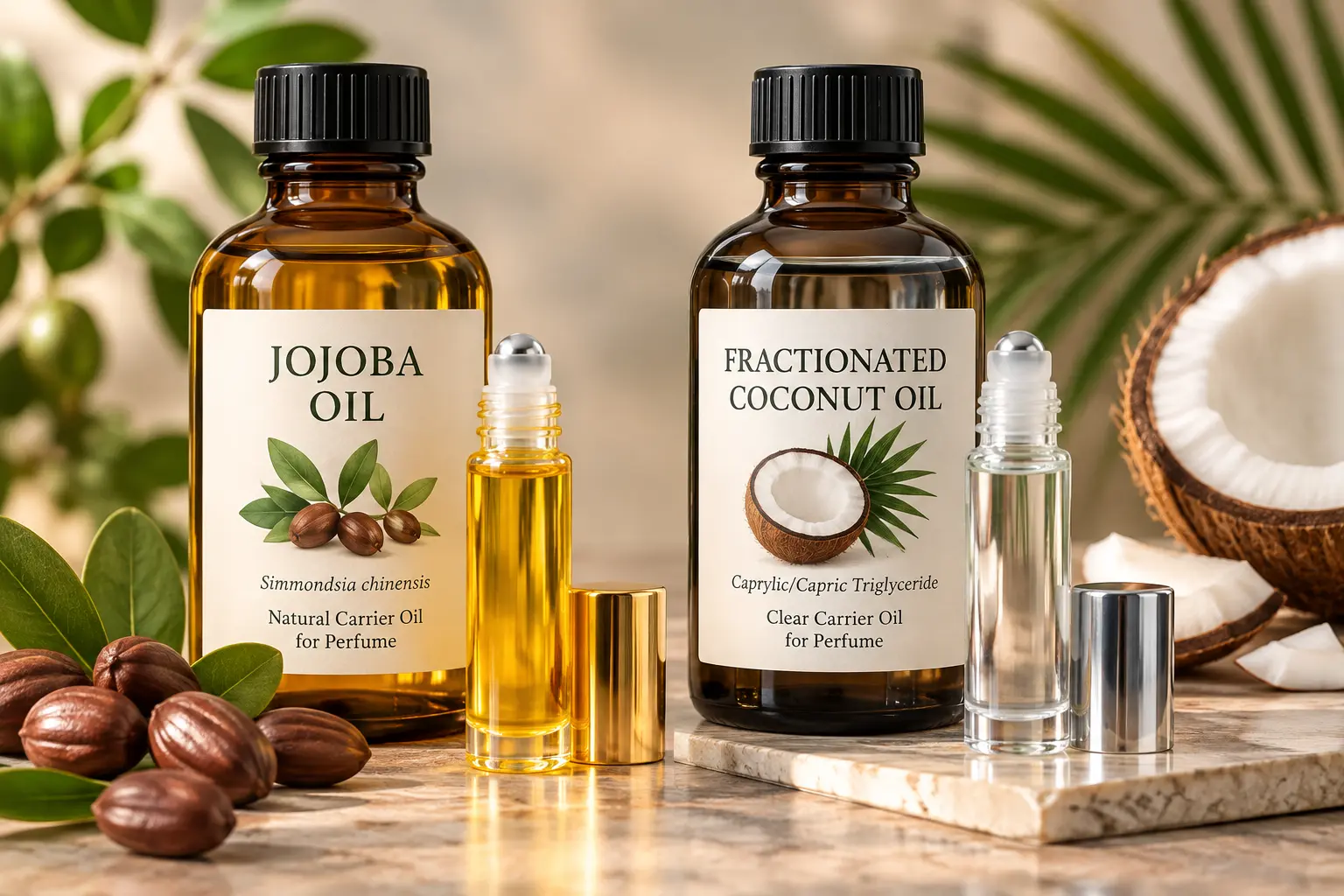
Short answer: in the jojoba vs fractionated coconut oil for perfume question, fractionated coconut oil (FCO) is the better all-round choice for most commercial roll-on perfume oils. It is water clear, close to odourless, stays liquid in cool rooms, resists oxidation very well and costs less in bulk. Jojoba oil is the better pick when you want a richer, silkier skin feel and a natural plant story on the label, and when your customers live somewhere warm. For oud and attar style blends, both work well, and many makers use a mix of the two.
At Bin Tammam Perfumes in Deira, Dubai, carrier choice is one of the questions we hear most often. The right answer usually depends on three things: where the product will be sold, what bottle it goes in, and how you want it to feel on skin.
Choose fractionated coconut oil for clear roll-on bottles, large batches, tight margins and stock that ships to cold countries.
Choose jojoba oil for premium or natural positioning, a satin skin feel and blends sold mainly in warm climates.
Blend both when you want some of jojoba’s feel at a lower cost per bottle.
For a wider list of options, see our guide to the best carrier oils for perfume making.
Jojoba Oil vs Fractionated Coconut Oil: Side-by-Side Comparison
Here is how the two carriers compare on the points that matter for perfume.
| Factor | Jojoba oil | Fractionated coconut oil |
| Origin | Pressed from the seeds of Simmondsia chinensis, a desert shrub native to Arizona, southern California and north-west Mexico. Farmed commercially in Argentina, Israel, Peru and elsewhere. | Made from coconut oil (coconut palm) by separating out the liquid, medium chain fraction. |
| Chemistry | About 97% liquid wax esters (a long chain fatty acid joined to a long chain fatty alcohol), with very few triglycerides. | Mainly caprylic/capric triglyceride, also called medium chain triglycerides (MCT). Lauric acid and longer chain fats are largely removed. |
| Scent | Golden (unrefined): faint nutty odour. Refined: odourless. | Odourless or very close to it. |
| Colour and clarity | Golden or colourless (refined). Clear when above its melting point. | Colourless and water clear. |
| Texture | Silky, slightly richer, more cushion on skin. | Thin, light, dry touch, spreads very easily. |
| Absorption | Sinks in well and leaves a soft, satin finish. | Spreads fast and leaves a light, low-grease finish. |
| Oxidation and shelf life | Very stable for a plant oil because it contains few triglycerides. One organic jojoba listing quotes 24 to 36 months. | Very resistant to oxidation and rancidity because its fatty acids are saturated. Long shelf life; follow the supplier’s certificate of analysis. |
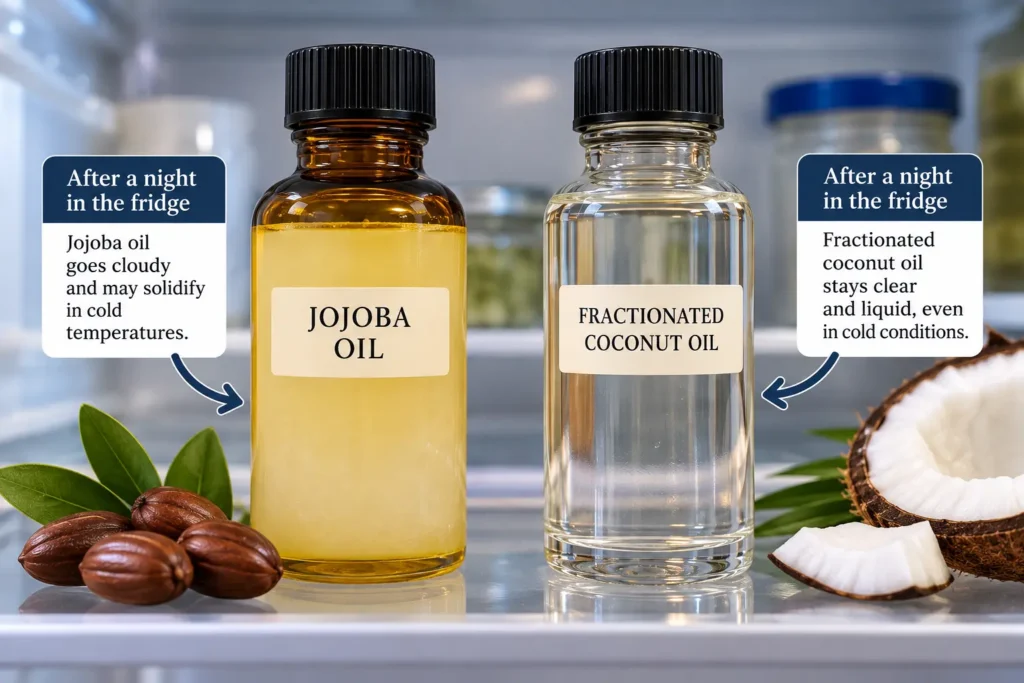
| Cold behaviour | Melting point around 10°C (reported freezing range 7 to 10.6°C). Goes cloudy, then solid, in the cold. Fully reversible. | Stays liquid in cool conditions where ordinary coconut oil would set. |
| Heat behaviour | Good resistance to high temperatures. | Stable and stays thin in heat. |
| Effect on longevity | Non-volatile. Keeps fragrance close to skin. Not a fixative in its own right. | Non-volatile. Keeps fragrance close to skin. Not a fixative in its own right. |
| Allergen notes | Not a nut or coconut product. Any ingredient can irritate some people, so patch test. | Coconut derived. Contact dermatitis to coconut products is reported, so flag it and patch test. |
| Cost in bulk | Higher. Jojoba is a slow-growing crop. | Lower and widely available. |
| Best for | Premium and natural ranges, attar style blends, warm markets, dry skin feel. | Clear roll-ons, large batches, private label at scale, exports to cold countries. |
What Is Jojoba Oil? Jojoba Oil for Perfume Making Explained
Jojoba (Simmondsia chinensis) is a desert shrub from the south-western United States and north-west Mexico. Although everyone calls it an oil, chemically it is a liquid wax: about 97% of it is made of wax esters, long straight molecules of 36 to 46 carbon atoms in which a fatty acid is joined to a fatty alcohol. Only a small fraction is made of triglycerides, the molecules that make up almost every other plant oil.
That chemistry explains its behaviour in perfume: it is far more shelf stable than most vegetable oils, and its relatively high melting point is why it clouds in the cold.
You will see two grades for sale. Unrefined (golden) jojoba is a clear golden liquid with a slight nutty smell. Refined jojoba is colourless and odourless. For perfume, the refined grade is usually the better choice because it does not tint the blend or add its own note.
Why makers like a jojoba carrier oil for perfume
Human sebum, the oil your skin produces, contains a significant share of wax esters (often quoted at around 25 to 30%). Jojoba is a plant wax ester, which is why it is so often described as the closest natural match to sebum. In practice, makers like it because it feels smooth and not sticky on skin, and it carries a “natural” story that suits premium attar ranges.
What Is Fractionated Coconut Oil? Fractionated Coconut Oil for Perfume Explained
Ordinary coconut oil contains lauric acid (12 carbons) and longer chain fats with higher melting points, which is why it sets solid in a cool room. Fractionation separates those heavier parts out, for example by cooling the oil and removing the solid portion. What remains is mostly the medium chain part: caprylic acid (8 carbons) and capric acid (10 carbons) bound as triglycerides.
On a cosmetic label this appears as Caprylic/Capric Triglyceride, and it is also sold as MCT oil. The Cosmetic Ingredient Review (CIR) Expert Panel has assessed it and concluded it is safe as used in cosmetics.
Why makers like fractionated coconut oil for perfume
It is colourless and water clear, so your fragrance looks exactly as it should in a clear roll-on.
It is odourless, so it does not compete with delicate top notes.
It stays liquid in cool rooms, fridges and winter deliveries.
It is light and thin, so the roller ball glides easily.
One caution: “liquid coconut oil” sold for cooking is not always the same product. For perfume, buy a cosmetic grade labelled Caprylic/Capric Triglyceride and ask for a certificate of analysis.
Scent, Colour and Clarity: Which Is the Best Unscented Carrier Oil for Perfume?
Both refined jojoba and fractionated coconut oil qualify as odorless carrier oils. Fractionated coconut oil is the more consistent of the two. Golden jojoba, by contrast, carries a faint nutty note and a yellow tint.
Under oud, amber, leather or heavy musk, you are unlikely to notice that note. In fresh citrus, aquatic or white floral blends, a golden carrier can dull the opening. When you test any unscented carrier oil for perfume, check three things:
- Smell: warm a few drops between your fingers and smell. There should be almost nothing.
- Colour: hold the bottle against white paper. Any yellow will show in a clear roll-on.
- Paperwork: a certificate of analysis with a batch number, so you can reorder the same quality.
Texture, Viscosity and Absorption on Skin
Viscosity is how thick an oil is and how fast it flows. Fractionated coconut oil is thin and fast flowing. It spreads widely, passes through a roller ball easily and leaves a light, dry finish. Jojoba is slightly richer. It feels silky and cushioned, absorbs well, and leaves a soft satin finish that many customers read as “luxury”.
Neither is right or wrong; it is about the feel you want your brand to have. If you sell roll-on perfume oil, put both on your wrist and decide which one you would rather sell.
Oxidation, Rancidity and Shelf Life
Oxygen, heat and light attack the double bonds in unsaturated fatty acids, and the oil slowly develops a stale, rancid smell that can spoil a fragrance. Both of these carriers do well here.
Jojoba has an oxidative stability index of approximately 60 under the AOCS test method. That makes it more stable than almond, safflower and canola oils, though less stable than castor oil and coconut oil. Fractionated coconut oil is made almost entirely of saturated medium chain fatty acids, which have no double bonds to oxidise, so it is very resistant to rancidity.
In practice, how you store finished stock matters more than the small difference between these two:
- Fill amber or opaque bottles, or keep clear bottles in boxes away from light.
- Keep caps tight and limit air space at the top of bulk containers.
- Store in a cool, dark room, never in a car or a sunny shop window.
- Record the batch number and fill date on every batch.
Our guide on how to store fragrance oils covers storage for concentrates and finished blends in more detail.
Does Fractionated Coconut Oil Make Perfume Last Longer?
The honest answer is: not on its own. Neither fractionated coconut oil nor jojoba is a fixative. A fixative is a material, such as certain musks, resins, ambers or woods, that slows the evaporation of the more volatile notes in a fragrance. Carrier oils do something different. They are non-volatile, so they do not evaporate like alcohol does. They hold the fragrance in a thin oil film on the skin, which gives the slow, close-to-skin wear that perfume oils are known for.
Because both carriers behave this way, the difference in longevity between them is small compared with the factors that really drive it:
- The concentration of fragrance oil in the carrier.
- The structure of the fragrance itself (oud, amber, musk and woods last far longer than citrus).
- Skin type, with drier skin tending to hold scent for less time.
- Heat and humidity, which change how quickly any fragrance opens up and fades.
We are not aware of published studies that compare perfume longevity in the two carriers directly, so be wary of anyone quoting exact hours. Your own wear test is the best guide.
Projection and sillage
Sillage is the trail a fragrance leaves in the air. Alcohol sprays project more because the alcohol evaporates quickly and lifts the scent. Both oil carriers wear closer to the body. If your customers want strong projection, an oil carrier is not the tool; a spray made with perfumer’s alcohol is.
Dry down
With a refined, odourless carrier, the dry down is the fragrance itself. Golden jojoba can add a faint nutty softness to the base notes, which some makers like in oud and sandalwood blends.
Heat and Cold: How Each Carrier Behaves in the UAE, GCC and Colder Markets
Summer temperatures across the Gulf regularly pass 40°C, while shops, malls and offices run on air conditioning.
In heat, both carriers stay liquid and stable. The bigger risk is to the fragrance, because heat speeds up the ageing of fragrance materials. Keep stock out of vehicles, sunny windows and rooftop storage.
In air-conditioned rooms, jojoba stays liquid because normal indoor settings are well above its melting point of around 10°C. You will not see clouding on a shop shelf in Dubai.
In the cold, the picture changes. Jojoba starts to go cloudy as it approaches 10°C and can set into a soft white solid in a fridge, a cold warehouse or a winter delivery to the UK, Canada or the northern USA. This is fully reversible: warm the bottle and it turns clear again with no loss of quality. The problem is commercial, not chemical, because a customer who receives a cloudy bottle may think it has gone off. Fractionated coconut oil avoids this, so it is the safer choice for exports to colder countries.
Skin Feel, Comedogenic Ratings and Allergies
A word on comedogenic ratings
Treat online “comedogenic scales” with caution. Many of the numbers came from rabbit ear tests, which dermatologists have criticised for producing false positives, and the FDA has no definition of “non-comedogenic”. For jojoba, a study using follicular biopsies on human skin found that refined, pure and hydrogenated jojoba oils did not differ significantly from the negative control in forming microcomedones. Either way, we would not make pore claims on a perfume label for either oil.
Coconut and nut sensitivity
Fractionated coconut oil comes from coconut, which is a fruit of the palm family and not a botanical nut. In January 2025 the US FDA issued final allergen labelling guidance that no longer treats coconut as a tree nut for food labelling. The Australasian Society of Clinical Immunology and Allergy (ASCIA) notes that allergic reactions to eating coconut are relatively rare, but that contact allergic dermatitis to coconut-derived products is more common. If a customer knows they react to coconut products, jojoba or another non-coconut carrier is the sensible choice, and they should take advice from their doctor.
Jojoba is a seed oil, not a nut oil. Sweet almond oil, a popular alternative carrier, is a tree nut oil and should be clearly labelled as such.
Patch test and IFRA
Whatever carrier you use, advise customers to patch test: apply a small amount of the finished, diluted perfume oil to the inner forearm and wait 24 to 48 hours before wider use. Remember that the fragrance oil contains its own potential allergens. IFRA Standards set maximum use levels for many fragrance materials by product type, and those limits apply to the finished product. Switching from jojoba to fractionated coconut oil does not change them. What matters is the percentage of fragrance oil in the bottle.
Price and Bulk Availability
Jojoba comes from a slow-growing shrub that is harder to cultivate than most oil crops, so per litre it generally costs more than fractionated coconut oil. Both are easy to source in bulk, but quality varies. Ask any carrier supplier for:
- A certificate of analysis for the actual batch you will receive.
- The grade (refined or golden jojoba; cosmetic grade caprylic/capric triglyceride).
- A safety data sheet and the manufacture or best-before date.
Work out the carrier cost per bottle at your planned dilution before you decide.
Which Should You Choose? Jojoba vs Fractionated Coconut Oil by Use Case
Roll-on perfume oils in clear bottles
Choose fractionated coconut oil. It keeps the blend water clear, does not cloud in winter and keeps unit costs down.
Attar style blends and oud perfume oils
Traditional attars are often worn concentrated, with little or no carrier. When you do dilute, jojoba suits the rich, close-wearing character of the style, and its faint warmth is hidden by the depth of oud, rose and sandalwood. If you sell Arabian attar oils or oud perfume oils mainly in the Gulf, where clouding is not an issue, jojoba or a jojoba and FCO blend is an excellent choice.
Private label perfume oil brands
Decide based on your positioning. A clean, natural or premium brand may prefer jojoba and list “Simmondsia Chinensis (Jojoba) Seed Oil” on the label. A brand built on value, consistency and wide distribution will usually be better served by fractionated coconut oil. If you are planning private label perfume oil, settle the carrier before you design the label, because it appears in the ingredient list.
Products shipped to cold countries
Choose fractionated coconut oil, or at least test any jojoba blend in a fridge overnight before you commit. Avoiding “my perfume has gone cloudy” complaints is worth more than the small difference in skin feel.
Hobbyists and first-time makers
Start with fractionated coconut oil, then buy a small bottle of refined jojoba and compare. Our step-by-step guide on how to make perfume oil at home walks through dilution, bottling and resting.
Can You Blend Jojoba and Fractionated Coconut Oil Together?
Yes. The two oils mix readily, and blending gives you some of jojoba’s satin feel at a lower cost. Test two or three ratios, for example mostly FCO with a smaller share of jojoba, and compare feel, clarity and cost. Always repeat the fridge test on the blend before selling it in cold markets, because any jojoba in the mix can still contribute to clouding.
What Can I Use Instead of Jojoba Oil? Alternatives Worth Knowing
If neither oil suits you, these are the most common alternatives for perfume:
MCT oil: essentially the same family as fractionated coconut oil. Buy a cosmetic grade labelled Caprylic/Capric Triglyceride.
Sweet almond oil: pleasant skin feel and affordable, but less oxidation stable than jojoba and a tree nut oil, so label it clearly.
Grapeseed oil: very light, but rich in polyunsaturated linoleic acid, which oxidises quickly. Studies show it degrades faster than most common oils, so it is a poor choice for stock that will sit on shelves.
Perfumer’s alcohol: not an oil at all. Use it for spray perfumes when you want projection and a lighter, faster drying feel.
For most makers, the best perfume carrier oil is still fractionated coconut oil or refined jojoba.
How to Test Both Carriers With Samples Before You Buy in Bulk
This is the test routine we suggest to our clients:
1. Order a small range of fragrances to test, for example through our fragrance sample kits, so you are testing your real scents rather than a generic one.
2. Make identical blends in both carriers at the same dilution, weighed rather than measured by eye, and label everything.
3. Let the blends rest for several days so the fragrance settles in the base.
4. Put one set in the fridge overnight and note any clouding. Leave another set in a warm room for a week and note any change in smell or colour.
5. Wear the two versions on opposite wrists. Note the opening, the heart and the dry down at 1, 4 and 8 hours.
6. Check the bottles again after four weeks for colour, clarity and any off notes.
Sourcing Perfume Oils and Private Label From Bin Tammam in Dubai
Bin Tammam Perfumes supplies wholesale perfume oils, fragrance oils, oud and attar oils and private label perfume oils from Deira, Dubai, to retailers, resellers and brands across the UAE, the GCC and worldwide. With more than 2,000 oil variations, over 15 suppliers, more than 1,000 clients and over 10 years in the industry, we work on a sample-first basis so you can test before you buy in volume.
When you talk to us, it helps to know:
- Whether you want concentrated oils to dilute yourself, or ready-to-wear perfume oils.
- Which carrier you plan to use, so we can suggest fragrances that suit it.
- Your target markets, so you can plan around cold shipping and labelling rules.
- Which documents you need for your own compliance checks, such as IFRA certificates and safety data sheets.
To request samples, discuss a private label range or get a wholesale quote, contact our Deira team.
Jojoba vs Fractionated Coconut Oil FAQ
Is jojoba oil better than coconut oil for perfume?
It is better than regular coconut oil, which sets solid in a cool room. Against fractionated coconut oil, it is different rather than better: richer in feel, while FCO is clearer, cheaper and does not cloud in the cold.
Can I use coconut oil instead of jojoba?
Use fractionated coconut oil, not ordinary or virgin coconut oil. The fractionated form stays liquid and is odourless. Regular coconut oil solidifies in cooler rooms and virgin grades smell of coconut, which will change your fragrance.
Does fractionated coconut oil make perfume last longer?
Not by itself, because it is not a fixative. Longevity depends mainly on the fragrance and its concentration.
What is the best carrier oil for perfume?
Fractionated coconut oil for most perfume oils; refined jojoba for a richer feel and a natural, premium position.
What can I use instead of jojoba oil?
Fractionated coconut oil or cosmetic grade MCT oil is the closest practical substitute. Sweet almond oil also works but is less stable and is a tree nut oil.
Why has my jojoba perfume oil gone cloudy?
It has been cold. Jojoba clouds and sets at around 10°C. Warm the bottle and it turns clear again, with no effect on quality.
What are the most odorless carrier oils for perfume?
Fractionated coconut oil and refined (colourless) jojoba. Avoid golden jojoba for fresh or delicate scents.
Do I need a carrier oil for attar?
Not always. Many traditional attars are worn concentrated. If you dilute, follow the IFRA guidance for the oil and choose jojoba for a richer feel or FCO for clarity and value.
Final Verdict: Jojoba vs Fractionated Coconut Oil for Perfume
When it comes to jojoba vs fractionated coconut oil for perfume, both are excellent carriers. Fractionated coconut oil wins on clarity, cost, cold stability and consistency, which makes it the practical default for roll-ons and private label ranges at scale. Jojoba wins on skin feel and natural appeal, and it is a strong choice for attar style and premium oils sold in warm markets such as the UAE and GCC. Test both with your own fragrances, decide which feel suits your brand, and then buy your fragrance oils from a supplier who will let you sample first.