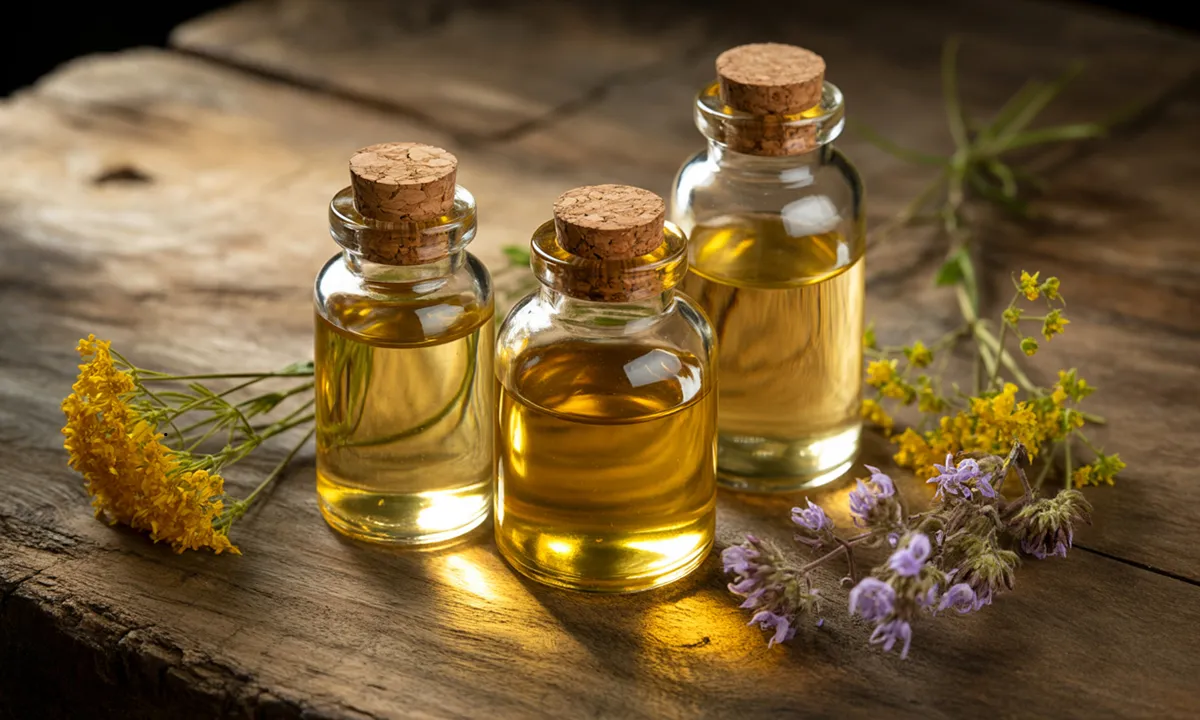

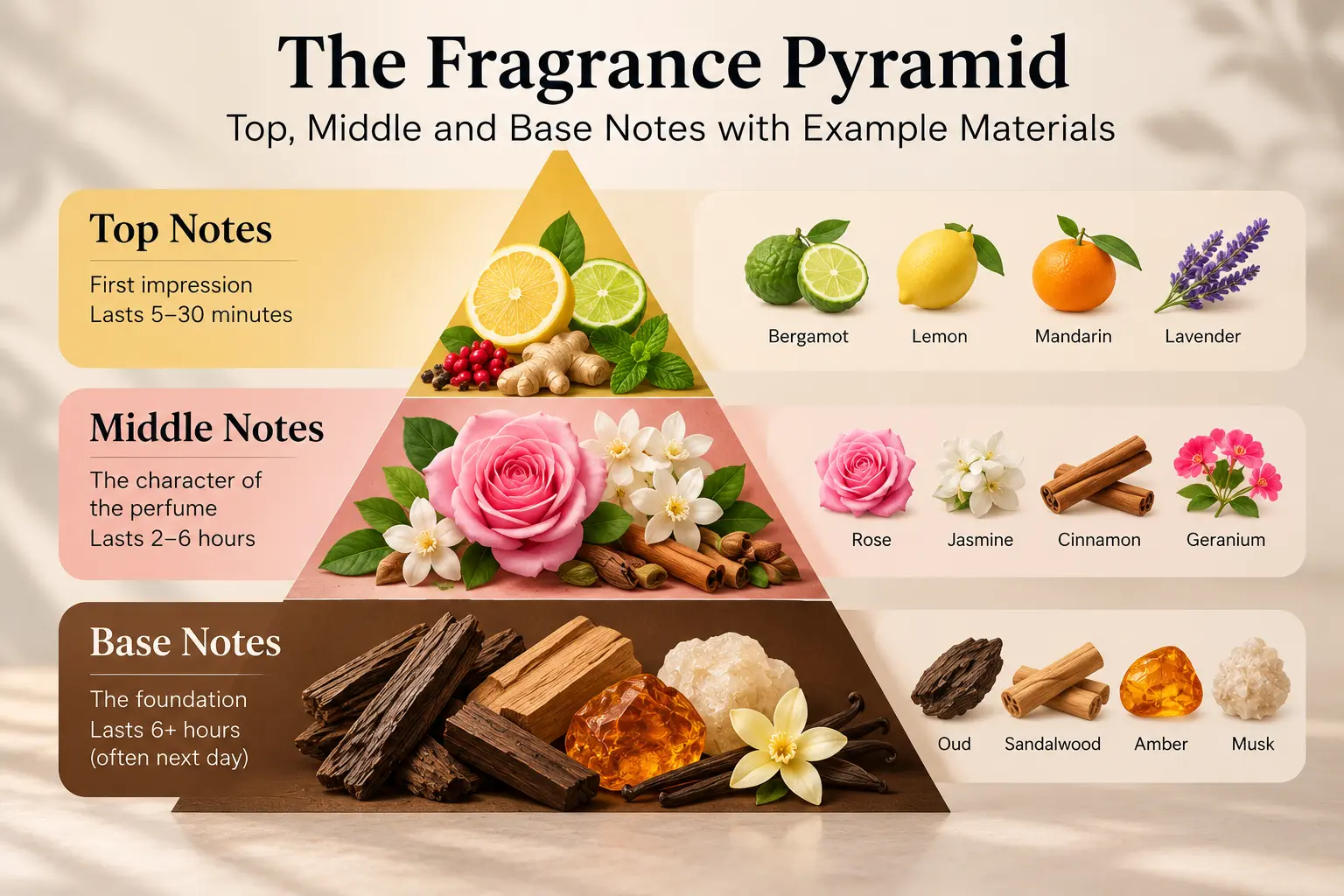
Fragrance notes explained simply: every perfume is built from materials that evaporate at different speeds, and perfumers group them into three tiers. Top notes are the small, light molecules you smell first, and they fade within minutes to roughly half an hour. Middle notes, also called heart notes, appear as the opening settles and carry the main character of the scent for the next few hours. Base notes such as oud, sandalwood, amber and musk evaporate slowly, anchor the blend and can still be detected many hours later, sometimes the next day. Together these three tiers form what the trade calls the fragrance pyramid.
We supply wholesale perfume oils to retailers, brands and resellers from our base in Deira, Dubai, and the note list is the first thing almost every buyer asks about. It is also the thing most often misread: a sample that smells bright on the first sniff can be quite different an hour later. Below we cover how each tier works, which materials sit where, how oils differ from sprays, how Gulf heat changes things, and how to read a note list when you buy in bulk.
What Are Perfume Notes?
A note is a description of a smell you can pick out in a perfume at a given point after you apply it. “Bergamot”, “rose” or “oud” on a note list tells you what the scent resembles, not necessarily which raw material is in the bottle. A rose note might come from Taif rose oil, from a rose absolute, from rose-smelling aroma chemicals such as phenylethyl alcohol, or from a mix of all three.
Notes are grouped by how quickly they evaporate. When several materials are blended so that they smell like one new idea, perfumers call the result an accord. Amber, covered below, is a classic example.
Two points matter for buyers. The tiers overlap: base notes are present from the start, just masked by the louder top. And each tier changes how the others smell. A citrus opening reads differently over musk than over oud.
The Fragrance Pyramid: How Top, Middle and Base Notes Fit Together
The fragrance pyramid is a diagram that puts top notes at the narrow tip, heart notes in the middle and base notes at the wide foundation. The idea is older, but the French perfumer Jean Carles turned it into a working method. Carles worked for the Roure house in Grasse and became the first director of the Roure perfumery school when it opened in 1946. He sorted materials into families such as citrus, floral, woody and musky, then ranked each family by how long it lasts: the most volatile as top notes, the middle group as heart notes and the longest lasting as base notes.
Carles composed from the bottom up, choosing the base accord first. Versions of his training method are still used to teach new perfumers.
Volatility and Evaporation: Why Notes Appear in Order
Volatility is how readily a material turns from liquid into vapour. Small, light molecules, like the limonene that dominates citrus peel oils, leave the skin quickly. Large, heavy molecules, such as the santalols in sandalwood or the musks used in modern perfumery, leave slowly. The perfumery author W. A. Poucher ranked materials on an evaporation coefficient from 1 to 100: roughly 1 to 14 for top notes, 15 to 60 for middle notes and 61 to 100 for base notes.
Dry Down, Sillage and Longevity: Terms Buyers Should Know
- Dry down: the later stage of a fragrance once the top notes have gone and the heart and base dominate. Judge an oil on its dry down, because that is what your customer lives with all day.
- Sillage: the trail a scent leaves in the air around the wearer. Alcohol sprays usually have more sillage than oils.
- Longevity: how long the scent stays detectable on skin. Base notes and fixatives drive longevity far more than top notes do.
- Fixative: a material, usually a musk, resin or wood, that slows the evaporation of lighter notes.
Top Notes: The First Impression
Top notes, also called head notes, are what a customer smells in the first moments after application. They matter commercially because the first impression is formed at the counter or when a sample vial is opened.
Materials that commonly sit in the top tier include:
- Citrus: bergamot, lemon, mandarin, sweet orange, grapefruit and lime
- Aromatic herbs: lavender, mint, basil and rosemary
- Light spices: pink pepper, cardamom and ginger
- Green and fruity notes: green leaves, galbanum, apple and pear
Bergamot (Citrus bergamia) is the benchmark citrus top note, and most of the world’s supply comes from Calabria in southern Italy. Cold-pressed bergamot contains bergapten, a furocoumarin that can cause skin reactions in sunlight, and IFRA (the International Fragrance Association) restricts its use in leave-on products. Perfumers often use a furocoumarin-free (FCF) grade for that reason. If you sell leave-on oils, ask how citrus materials in a blend comply.
On skin, most top notes are clearly noticeable for somewhere between a few minutes and about half an hour. In hot weather they still go faster.
Middle Notes (Heart Notes): The Character of the Perfume
The heart emerges as the top notes thin out. It tells you what kind of perfume you are wearing: rosy, spicy, powdery, fruity or green.
Common heart notes include:
- Florals: rose, jasmine, orange blossom, ylang-ylang, tuberose, iris and geranium
- Warm spices: saffron, cinnamon, clove and nutmeg
- Fruity heart notes: plum, peach and raspberry
Heart notes usually become noticeable within the first 20 minutes or so and can carry the scent for several hours, depending on the materials and how heavily they are dosed.
Saffron as a Middle Note
Saffron comes from the dried stigmas of the Crocus sativus flower, and its main aroma compound is safranal. In perfumery it reads leathery, honeyed and slightly metallic, and perfumers mostly place it in the heart, where it warms rose, oud and leather accords. Because real saffron is so costly, most saffron notes are built around safranal and related aroma chemicals. Saffron, rose and oud is one of the most recognisable combinations in Middle Eastern perfumery.
Base Notes in Perfume: Depth, Fixation and Longevity
Base notes are the heavy, slow-evaporating materials at the bottom of the pyramid. They are often not noticed clearly until about half an hour after application, and some, particularly musks and animalic notes, can still be detected more than 24 hours later. Base materials also act as fixatives, holding lighter notes in place and giving the blend body.
- Woods: oud, sandalwood, cedarwood, vetiver and patchouli
- Resins and balsams: frankincense, myrrh, benzoin and labdanum
- Sweet notes: vanilla and tonka bean
- Musks and ambery materials: white musks, Ambroxan and amber accords
Oud as a Base Note
Oud, also called agarwood, forms in the heartwood of Aquilaria trees after they are wounded and infected by fungi. The tree produces a dark, fragrant resin as a defence, and that resin-saturated wood is distilled into oud oil, known in Arabic as dehn al oud. Depending on origin, age and distillation, it can smell woody, leathery, smoky, animalic or sweet.
Because of overharvesting, agarwood-producing Aquilaria and Gyrinops species are listed in Appendix II of CITES, which controls international trade in them. Natural oud oil is scarce and expensive, so many commercial oud oils use oud accords, sometimes with a portion of natural oil. Our oud perfume oils wholesale covers both smoky and sweet oud profiles for resellers in the Gulf and beyond.
Amber Notes Versus Ambergris
Amber notes in perfume are not made from fossil amber. Amber is an accord, usually built from labdanum (a resin from the rockrose shrub), vanilla or vanillin and often benzoin, which together give a warm, sweet, resinous base. Ambergris is a different material altogether: a waxy substance produced by sperm whales and historically prized as a fixative. It is rarely used today, and its effect is usually recreated with Ambroxan, a synthetic made from sclareol, which comes from clary sage.
How Do Musky Notes Contribute to Long-Lasting Fragrance?
Musk was originally taken from a gland of the male musk deer, which is now a protected species. The musks used in perfumery today are synthetic. Several older nitro musks have been prohibited or restricted under IFRA Standards, and macrocyclic musks are now widely used. Musk molecules are large and evaporate very slowly, so they stay close to the skin for hours and help slow the loss of lighter notes. That is why a small amount of musk can extend the life of a floral or citrus blend.
Top vs Middle vs Base Notes at a Glance
| Feature | Top notes | Middle (heart) notes | Base notes |
| Also called | Head notes | Heart notes | Soul notes |
| Volatility | Highest | Moderate | Lowest |
| Poucher evaporation coefficient | 1 to 14 | 15 to 60 | 61 to 100 |
| When you notice them | Immediately | As the opening fades | Clearly from around 30 minutes |
| Typical presence on skin | A few minutes up to about half an hour | Several hours | Many hours; some musks over 24 hours |
| Main job | First impression | Main character | Depth, fixation, longevity |
| Example materials | Bergamot, lemon, mandarin, pink pepper, lavender | Rose, jasmine, saffron, orange blossom, cinnamon | Oud, sandalwood, amber, musk, vanilla, patchouli |
Timings are general guides. Concentration, skin type, climate and the full formula all change how long each tier lasts.
Perfume Notes in Oil-Based Perfumes vs Alcohol Sprays

The notes themselves behave the same way chemically in both formats, but the wearing experience is different. In an alcohol spray the ethanol evaporates within seconds and carries the most volatile notes off the skin with it, which gives a big, airy opening and more sillage. In a perfume oil there is no alcohol to lift the scent. The fragrance sits in a perfume base oil (a carrier such as fractionated coconut oil or jojoba), stays close to the skin and releases more slowly.
What this means in practice:
- The opening of an oil is softer. Bright citrus tops feel less explosive than they do in a spray.
- Heart and base notes show sooner.
- Oils usually project less but stay on skin for longer.
- The carrier matters. A heavy or scented carrier can dull top notes, which is why our guide to the best carrier oils for perfume making recommends light, odorless options.
Arabian Note Profiles: Oud, Rose, Saffron, Amber and Frankincense
Arabian perfumery leans heavily on the heart and the base. Where a classic European cologne is built around a citrus top, a traditional Gulf perfume oil is often built around oud, rose, saffron, amber, musk and sandalwood, with a shorter, quicker opening.
Attar, Dehn al Oud and Bakhoor
Attar traditionally means a natural perfume oil. In the classic method still used in Kannauj, India, flowers, herbs or spices are hydrodistilled in a copper still called a deg, and the vapour is carried into a receiving vessel called a bhapka that holds sandalwood oil, which absorbs the aroma. Dehn al oud is pure oud oil. Bakhoor is different again: wood chips, traditionally agarwood, soaked or blended with oils and resins and burned over charcoal. In Dubai and across the Gulf, bakhoor is part of hospitality, used to welcome guests and burned on Fridays, during Ramadan and at Eid.
Our Arabian attar oils wholesale collection follows these traditional profiles, with rich rose, oud, amber and musk bases that suit buyers in the UAE, Saudi Arabia and the wider GCC.
Taif Rose, Frankincense and Sandalwood
Taif rose is a 30-petal Damask rose (Rosa damascena trigintipetala) grown around Taif in Saudi Arabia, high in the Hejaz mountains at roughly 1,800 metres. The flowers are picked in spring and distilled into rose oil and rose water. The mountain climate gives it a profile distinct from European or Turkish Damask roses. As a heart note it pairs naturally with saffron and oud.
Frankincense comes from Boswellia trees, and Boswellia sacra from the Dhofar region of southern Oman is among the most valued. The Land of Frankincense sites in Dhofar, including the frankincense trees of Wadi Dawkah, were added to the UNESCO World Heritage List in 2000. In a blend, frankincense gives a clean, resinous and slightly lemony lift, and its incense character carries on into the base, so it often bridges tiers.
Sandalwood (Santalum album), traditionally associated with Mysore in India’s Karnataka state, owes its creamy, soft woodiness to santalols. It is one of the classic fixatives and the traditional base for attars. Genuine Mysore oil is now very hard to obtain, so many sandalwood notes today rely on other Santalum species or synthetic sandalwood molecules.
How Heat and Humidity in the UAE and Gulf Affect Fragrance Notes
Dubai summers are hot and humid. Daytime highs regularly pass 40°C in July and August, and humidity along the coast is often high. Heat speeds up evaporation, so the lightest notes go first and fastest. A citrus opening that feels lively on a cool evening disappears far faster outdoors in a Gulf summer.
Warm skin also pushes heavier notes out more strongly, so dense oud and amber bases can project harder than expected.
Practical points for anyone selling into the UAE and GCC:
- Do not rely on a citrus top for the identity of a summer product. Anchor it with a clean musk or light wood so it still smells finished once the top has gone.
- Test samples outdoors in the heat and indoors with air conditioning.
- Position heavy oud and amber oils for evenings and the cooler months, and lighter musks and florals for daytime summer wear.
- Store stock away from heat and direct sunlight.
Notes Behind Popular Fragrance Styles
Which Notes Are Commonly Found in Musky Body Oils?
Musky body oils are usually built on synthetic white musks, with a soft powdery or floral heart such as iris, violet or light white flowers, and a touch of sandalwood, vanilla or amber in the base. Many carry a light top of bergamot, pear or aldehydes. The aim is a clean, skin-close scent with more base than top.
How Do Woody Notes Contribute to Dark Floral Fragrances?
In a dark floral the heart is usually rose, tuberose or jasmine, sometimes with plum or other dark fruit. Woody base notes give it weight and shadow: patchouli adds earthy depth, oud adds smoke and leather, and sandalwood and cedarwood add a dry or creamy floor. The woods also fix the floral heart so it lasts longer.
How Do Green and Woody Notes Shape Forest Fragrances?
Forest-style scents open with green notes such as crushed leaves, galbanum, pine, fir needle and cypress, which are fresh and fairly volatile. The heart often carries more conifer and herb notes, and the base uses cedarwood, vetiver, moss notes and sometimes smoky or incense-like woods. The greens create the outdoor feeling; the woods keep it going.
How to Read a Note List When Buying Wholesale Perfume Oils
A note list is a description, not an ingredient declaration. Two oils with identical lists can smell and perform very differently. Use it as a starting point, then check:
- Balance between tiers. A list with five top notes and one base note will probably fade fast, especially in Gulf heat.
- Fixatives. Look for musk, amber, woods, resins or vanilla. These decide longevity.
- Natural or accord. Ask whether key notes such as oud, rose and sandalwood are natural, blended or accords, and understand the perfume oil grades you are being quoted for.
- Compliance. Ask for IFRA documentation and a safety data sheet for the market you sell into.
- Dry down. Smell on a strip and on skin at intervals: on opening, after 30 minutes, after two hours and after six hours.
This is why we work samples first. Our fragrance sample kits let you wear oils through the full dry down before you commit to a bulk order, so you buy on performance rather than on a note list.
How to Balance a Blend Across Top, Middle and Base Notes
For brands developing their own oils, a few principles keep blends stable and wearable:
- Start with the base. Following Carles, decide what the scent should smell like after several hours and build from there.
- Make the heart the identity. It is what customers remember.
- Use the top to introduce the heart, not to fight it. Bergamot over a rose heart works well; a sharp mint over a heavy oud base usually clashes.
- Add fixatives in small steps. Too much musk or amber can flatten the top and heart.
- Rest and retest. Many perfumers let a new blend rest for some days before final judgement, because the smell can change as it settles.
If you are mixing for the first time, our step-by-step guide on how to make perfume oil at home covers dilution, carriers and testing.
Common Mistakes With Top, Middle and Base Notes
- Judging an oil in the first 30 seconds, when only the top notes are speaking.
- Testing too many oils in one session. The nose tires quickly, so test a few at a time and take breaks in fresh air.
- Overloading the top to win the first sniff, leaving a thin dry down.
- Layering two dense bases, such as heavy oud with a thick amber, which can turn muddy.
- Ignoring climate. A blend tested in a cool showroom can wear very differently on a hot street.
How Bin Tammam Can Help
Bin Tammam Perfumes has supplied the fragrance trade from Deira, Dubai for more than 10 years. We work with 1000+ clients, source from 15+ suppliers and carry 2,000+ oil variations, from fresh citrus and clean musk profiles to deep oud, rose and amber.
- Brands and manufacturers that need fragrance in volume can choose from our wholesale fragrance oils, with clear note breakdowns for each profile.
- If you want to sell under your own name, our private label perfume oils service helps you pick profiles with the right top, heart and base balance for your market.
- Every bulk order can start with samples, tested in your own climate.
Tell us the notes, styles or reference scents you are looking for, and contact our Deira team for samples and wholesale pricing.
Frequently Asked Questions About Perfume Notes
How long do top notes last on skin?
Usually from a few minutes to about half an hour. Citrus and light herbal notes fade quickest, and heat shortens their life further.
What are base notes in perfume, and why do they last longest?
Base notes are heavy, low-volatility materials such as oud, sandalwood, vetiver, amber, vanilla and musk. Their large molecules evaporate slowly, so they remain on skin for many hours and act as fixatives for the lighter notes.
Is saffron a top note or a middle note?
Saffron is mostly used as a middle note. Its leathery, honeyed warmth sits in the heart, where it links rose and oud, although a little of it can be noticed early in the opening.
Is oud always a base note?
Yes, in almost every composition. Oud is dense and slow to evaporate, so it anchors the base.
What is a perfume base oil?
A perfume base oil, or carrier oil, is the odourless or near-odourless oil that a fragrance concentrate is diluted in to make a perfume oil. Fractionated coconut oil and jojoba are common choices. It is not the same thing as base notes.
What are amber notes made from?
Amber notes are an accord, usually built from labdanum, vanilla or vanillin and often benzoin. They are not made from fossil amber, and they are different from ambergris, which is now mostly recreated with Ambroxan.
Do perfume oils have the same notes as alcohol sprays?
The notes can be the same, but they wear differently. Oils have a softer opening, show the heart and base sooner and stay closer to the skin, while sprays project more and lose their top notes faster.
Fragrance Notes Explained: What Buyers Should Take Away
With fragrance notes explained, the practical lesson is simple. The top sells the first sniff, the heart defines the character and the base decides if your customer is still happy six hours later. Read note lists for balance and fixatives, test through the full dry down, and allow for Gulf heat. Do that and you will choose oils that perform on your customers’ skin, in their climate, for the whole day.